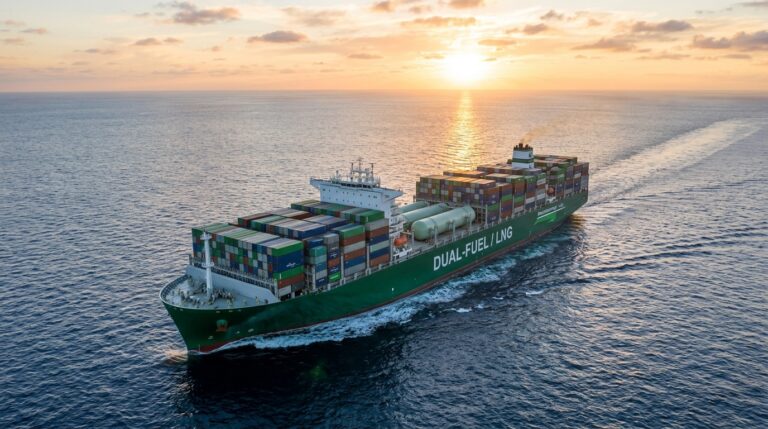

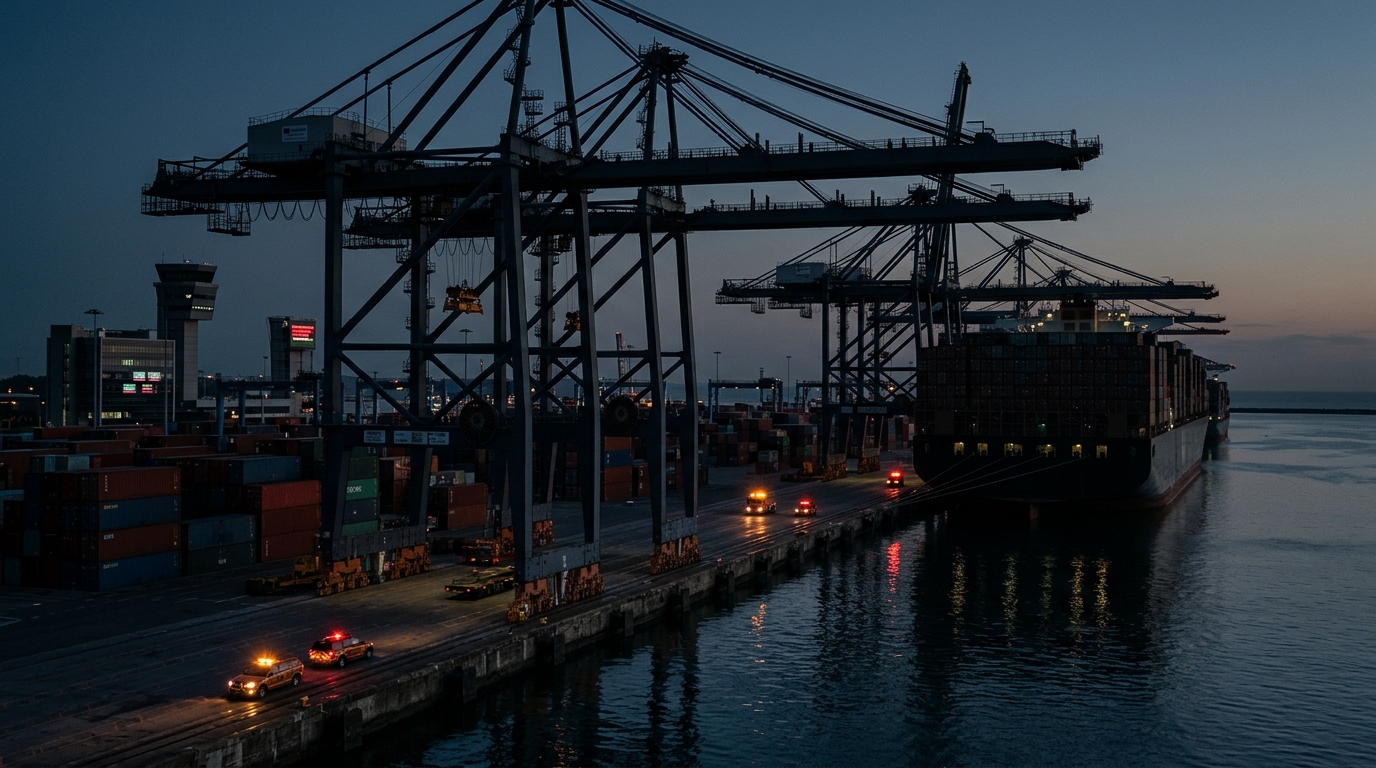
At 06:00 AM on a clear Friday, a line of 200 heavy commercial trucks idles along the port approach highway, engines humming in low unison. Their drivers clutch digital gate passes and customs release slips, waiting for the automated optical character recognition (OCR) gantries to grant entry.
Inside the central control tower, the monitors that govern thousands of 40-foot container movements suddenly flicker, cycle through reboot loops, and freeze. The Terminal Operating System (TOS)—the digital brain synchronizing quay cranes, automated guided vehicles (AGVs), reefer monitoring grids, and gate scanners—refuses to acknowledge inputs. Within sixty minutes, the gate turnstiles lock shut. Towering ship-to-shore gantry cranes halt mid-pick over a 15,000-TEU ultra-large container vessel.
There are no blown transformers, no physical explosions, and no stormy seas.
Yet, one of the busiest maritime trade hubs in the hemisphere has gone completely dark.
In boardrooms across the world, supply chain managers receive a chilling notification: Operations suspended indefinitely due to a critical cybersecurity event.
This is not a Hollywood script or speculative cyber-fiction. It is the precise reality that has played out across some of the world’s most critical maritime choke points. As ports evolve into hyper-connected, automated industrial data hubs, the vulnerability of global trade has shifted from physical chokepoints like the Suez Canal to invisible vulnerabilities within digital networks.
Can a cyberattack bring global maritime trade to a standstill? To answer this, we must examine the digital architecture of modern ports, the anatomy of real-world attacks, and what importers, exporters, and manufacturers must do to build genuine operational resilience.
The Illusion of Invulnerability: How Modern Ports Actually Run
For over a century, port resilience was measured in concrete and steel: the depth of draft channels, the bollard pull of tugboats, and the structural integrity of breakwaters.
Today, a container terminal is essentially an industrial data center with a waterfront.
A single container moving from an industrial cluster in Pune or Gujarat through Nhava Sheva (JNPT) to Rotterdam or Jebel Ali requires thousands of automated data handshakes before it ever touches a vessel. The modern smart port relies on three deeply intertwined layers:
- Enterprise IT & Data Layer: Electronic Data Interchange (EDI) feeds, national single-window customs systems (like India’s ICEGATE), shipping line booking APIs, and port community networks.
- The Terminal Operating System (TOS): Software platforms (such as Navis N4, Tideworks, or CyberLogitec) that optimize yard stacking, calculate crane split algorithms, and sequence vessel stowage plans.
- Operational Technology (OT) & Industrial Controls: SCADA networks, Programmable Logic Controllers (PLCs), remote crane tele-operation consoles, automated gate OCR sensors, and automated reefer temperature monitoring grids.
When malicious actors target a port, they rarely need to hack a 1,000-ton crane directly. Instead, compromising the orchestration layer paralyzes the machinery. A quay crane cannot safely lift a container if the system cannot confirm its gross mass, hazardous materials declaration, customs clearance status, or exact yard slot allocation. Without digital verification, mechanical operations ground to an absolute halt to prevent catastrophic logistical errors or maritime disasters.
Real-World Wake-Up Calls: When Digital Attacks Crippled Physical Trade
The maritime industry’s cyber-threat landscape is documented by a trail of high-profile, systemic disruptions across leading economies:
1. DP World Australia (November 2023)
In November 2023, unauthorized activity was detected on the corporate network of DP World Australia. To contain the breach, engineers severed the terminal systems from the internet. The security containment was effective, but disconnecting the network immediately halted land-side freight operations across Sydney, Melbourne, Brisbane, and Fremantle. Four terminals handling 40% of Australia’s maritime freight were locked down for three days. Over 30,000 shipping containers—including refrigerated reefers holding temperature-sensitive pharmaceuticals and perishable food items—were trapped at the docks, triggering national emergency response protocols.
2. Port of Nagoya, Japan (July 2023)
Nagoya is Japan’s largest commercial port, handling roughly 10% of the nation’s total trade volume and serving as the primary export gateway for the automotive manufacturing corridor. A ransomware attack launched by the LockBit 3.0 cyber syndicate infected the Nagoya Port Unified Terminal System (NUTS). The attack encrypted critical servers, terminating all container loading and unloading operations for two and a half days. Thousands of commercial trucks clogged transit expressways, and automotive assembly lines faced severe component starvation.
3. Jawaharlal Nehru Port Trust / JNPT (2017 & 2022)
India’s primary container gateway has witnessed the threat firsthand. During the 2017 NotPetya global infection, APM Terminals Gateway Terminals India (GTI) at Nhava Sheva saw its automated tracking and gate management systems paralyzed, forcing port staff to process paperwork manually on makeshift desks to avert port chokeoffs. In February 2022, another targeted ransomware incident disabled the management information systems (MIS) at JNPCT, compelling port authorities to divert scheduled container vessels to alternate regional terminals.
Anatomy of a Blackout: What Actually Happens When a Terminal Is Breached?
To comprehend the financial velocity of a maritime cyber outage, business leaders must view the crisis through its distinct operational stages:
Stage 1: The Land-Side Gridlock
Within two to four hours of a port’s IT/OT systems going offline, local infrastructure begins to collapse under the pressure of incoming cargo. Modern port terminals operate on “Just-in-Time” vehicle booking systems. When gate verification servers drop offline, container yards stop accepting incoming export boxes or releasing imported loads. Drayage trucks back up for miles onto regional highways, generating thousands of dollars per vehicle in idle driver wages, fuel burn, and detention charges.
Stage 2: The Waterside Bottleneck
A container vessel burns fuel every hour it idles. When gantry operations stop, arriving vessels cannot discharge or load. Feeder and mother vessels must drop anchor in outer anchorage zones or execute emergency diversions to adjacent ports. However, neighboring terminals are rarely equipped to absorb tens of thousands of unplanned TEUs without triggering multi-week berthing queues. Transshipment schedules across entire trade lanes disintegrate.
Stage 3: The Customs and Compliance Vacuum
Cargo cannot legally clear without regulatory authorization. In India, systems like ICEGATE and port community networks exchange millions of Electronic Data Interchange (EDI) messages daily with shipping lines, banks, and customs house agents. If this communication bridge is cut, customs officers cannot cross-verify Bills of Entry, shipping bills, customs duties, or scanning protocols. High-value cargo becomes legally immobilized.
The Commercial Fallout for B2B Cargo Owners
For manufacturing executives, procurement managers, and commercial traders, the damage of a port cyber outage is calculated in direct financial losses:
- Uncontrollable Demurrage & Detention Disputes: When a terminal freezes, containers trapped inside continue to rack up billable calendar days. While carriers and terminal operators often declare force majeure during extended cyber disasters, sorting out contested demurrage and detention bills takes months of contentious legal and administrative negotiations.
- Factory Line Starvation: Modern manufacturing relies on lean inventory. An automotive assembly plant or electronics manufacturing facility in Maharashtra, Tamil Nadu, or the American Midwest might hold only three to five days of raw inventory. When imported sub-assemblies or specialized chemicals are locked inside an inaccessible terminal yard, multi-million-dollar production lines grind to an abrupt halt.
- Perishable and Cold Chain Catastrophes: Reefer containers carry seafood, fresh fruit, pharmaceuticals, and sensitive biologicals requiring active power and hourly temperature monitoring. During an uncoordinated system shutdown, technicians often lose centralized digital telemetry. If yard access is closed to maintenance crews, millions of dollars in temperature-sensitive cargo can spoil in the tropical heat within days.
- Banking and Letter of Credit (LC) Breaches: International trade contracts are tied to strict documentary deadlines. When a container cannot be loaded onto the vessel named in a commercial Letter of Credit before the expiry date, banks may refuse payment. Exporters face costly renegotiations, discounted sales, or outright contract cancellations from overseas buyers.
5 Pragmatic Steps Every Shipper Must Take to Build Cyber Resilience
Logistics and risk management directors cannot control whether a terminal gets attacked. However, businesses can control their own vulnerability and operational response. Here are five practical strategies that cargo owners moving goods through major trade corridors should implement immediately:
1. Eliminate Single-Gateway Complacency
Never route 100% of critical supply chain volume through a single marine terminal or shipping line. If your primary supply line runs through Nhava Sheva (JNPT), establish secondary operational workflows through Mundra, Hazira, or Pipavav. In transpacific or transatlantic trade, ensure your distribution networks can accept freight routed through alternate gateways (e.g., Savannah vs. New York, or Rotterdam vs. Antwerp).
2. Maintain Immutable Offline Documentation
When an international terminal’s systems are attacked, the biggest operational obstacle is proving who owns what. Terminal operators often lose track of physical container inventories in the yard. Maintain automated, encrypted, cloud-based repositories of all critical shipping documentation including Bills of Lading, Commercial Invoices, Packing Lists, Certificates of Origin, and Customs Out-of-Charge receipts. Having these documents on hand allows your customs broker to push for manual emergency clearance the moment terminal gates establish manual contingency desks.
3. Establish Pre-Agreed Emergency Multimodal Runbooks
Do not wait for a port outage to establish relationships with air cargo operators or bonded cross-border truckers. Formulate a verified playbook: if ocean freight at a primary port is blocked for more than 72 hours, automatically divert upcoming high-priority shipments to an expedited air freight corridor, or pre-clear customs bonded road transport permits to redirect arriving inbound cargo to inland container depots (ICDs) or free trade warehousing zones (FTWZs).
4. Review Force Majeure and Marine Cargo Insurance Policies
Standard marine cargo insurance protects against physical damage, sinking, fire, and piracy. It frequently excludes losses caused by delay, system downtime, or cyber-induced commercial disruption under standard Cyber Attack Exclusion Clauses (CL 380). Review your marine policy with your insurance underwriter. Ensure you have adequate endorsements covering cyber incidents, mechanical breakdown of port infrastructure, and extended refrigeration failure.
5. Anchor Your Supply Chain to an Agile, Networked Freight Forwarder
When an ocean carrier’s proprietary booking portal drops offline due to a ransomware attack, shippers who booked directly with that single carrier are left stranded with no direct contact points. An experienced, vendor-neutral international freight forwarder provides critical operational insulation. Forwarders monitor operational indicators across dozens of terminals, manage multi-carrier contracts, and possess the ground-level agility to re-route, re-book, and re-manifest your cargo before it enters a compromised bottleneck.
How SeaTrans Agencies Protects Your Cargo in an Unpredictable World
At SeaTrans Agencies Pvt. Ltd., we believe that true logistics excellence is tested not on the quiet days, but during unforeseen global disruptions. With over 25 years of operational heritage, SeaTrans has guided businesses safely through geopolitical crises, global port congestions, labor strikes, and digital blackouts.
When unexpected bottlenecks threaten your supply chain, SeaTrans delivers proactive, hands-on contingency execution:
- Ocean Freight Flexibility (FCL/LCL): Long-standing contracts across leading international container lines, granting us the agility to divert bookings across alternate gateways in India, the Middle East, Southeast Asia, Europe, and the Americas. Explore our Ocean Logistics & Freight Services.
- Rapid-Response Air Logistics: When ocean terminals lock down, our air freight team rapidly transitions urgent components to scheduled air cargo charters and consolidations. Learn more about our Expedited Air Freight Solutions.
- Customs Consultation & Regulatory Expertise: Our specialists cut through customs red tape, ensuring all paperwork complies with international standards to accelerate manual release protocols during administrative system failures.
- Door-to-Door & Cross-Trade Execution: From factory pickup to final inland distribution, our presence in key hubs like Mumbai, Delhi-NCR, and Dubai ensures your cargo remains visible, accounted for, and protected.
We do not promise a world free of disruptions. We deliver the operational foresight, diversified routing, and hands-on logistics management required to keep your business moving—no matter what happens on the docks.
The Road Ahead: The Future of Maritime Cyber Defense
The maritime sector is racing to harden its defenses. The International Maritime Organization (IMO) has mandated that maritime cyber risk management be integrated into safety management systems under the ISM Code (Resolution MSC.428(98)). Concurrently, authorities such as the European Union (through the NIS 2 Directive) and the United States Coast Guard are enforcing mandatory minimum cybersecurity standards for port facility operators, mandating zero-trust architectures, strict network segmentation between IT and OT, and mandatory breach notification timelines.
Yet, technology alone cannot eliminate vulnerability. As autonomous container ships, remote-controlled cranes, and AI-driven automated terminals become the baseline for global trade, the attack surface expands every day. The winners in global trade will not be the companies that assume their trade corridors are immune to cyber disruption. The winners will be the pragmatic organizations that recognize the risks, prepare agile contingency protocols, and align with logistics partners who know how to navigate the storm when the screens go dark.
Frequently Asked Questions (FAQs)
1. Does standard marine cargo insurance cover losses caused by port cyberattacks?
Most standard marine cargo policies (Institute Cargo Clauses A, B, or C) focus on physical loss of or damage to goods caused by maritime perils (such as sinking, collision, or heavy weather). Many standard policies explicitly include a Cyber Attack Exclusion Clause (CL 380), which excludes losses directly caused by cyberattacks. Furthermore, economic losses resulting from port delay or commercial market loss are routinely excluded. Shippers should consult their insurance brokers to obtain specialized Cyber Cargo endorsements and contingent business interruption riders.
2. Can a cyberattack shut down customs clearances at major Indian ports like Nhava Sheva (JNPT) or Mundra?
Yes. Indian container ports rely heavily on digital integrations with ICEGATE, the National Logistics Portal-Marine (NLP-M), and individual port community systems for filing Bills of Entry, generating customs out-of-charge (OOC) orders, and releasing e-gate passes. If a ransomware event or systemic breach hits either the central customs servers or the terminal’s management information system (as occurred at JNPCT in February 2022), automated gate processing stops. In such cases, customs authorities must invoke manual business continuity plans, resulting in clearance delays and yard congestion.
3. How does partnering with an experienced freight forwarder mitigate the risk of port cyber disruptions?
An experienced freight forwarder acts as an agile shock absorber. Direct shippers booking solely through a single shipping line’s web portal often face complete communication cut-offs if that carrier’s infrastructure is attacked. In contrast, an established forwarder like SeaTrans Agencies operates with multi-carrier contracts, diversified port relationships, multi-modal transport licenses (MTO), and an international partner network. If a terminal or carrier goes down, an agile forwarder can immediately redirect incoming freight, divert scheduled voyages to alternate ports, transfer critical freight to air or intermodal rail, and manage the administrative documentation needed to clear containers without crippling detention penalties.
Ready to Build a More Resilient Supply Chain?
Don’t let unforeseen maritime bottlenecks, regulatory shifts, or terminal shutdowns compromise your commitments to your customers.
Speak with the SeaTrans Logistics Team Today to review your international trade lanes, evaluate alternative routing contingencies, and experience the security of shipping with 25+ years of proven expertise.
References & Verifiable Sources
- International Maritime Organization (IMO): Maritime Cyber Risk Management in Safety Management Systems (Resolution MSC.428(98)). imo.org
- The Baltic and International Maritime Council (BIMCO): The Guidelines on Cyber Security Onboard Ships. bimco.org
- European Union Agency for Cybersecurity (ENISA): Port Cybersecurity – Good Practices for Cybersecurity in the Maritime Sector. enisa.europa.eu
- Reuters: DP World says hackers stole Australian ports employee data; operations suspended for 30,000+ containers. reuters.com
- The Times of India: India’s largest container port JNPT hit by ransomware attack affecting APM Terminals Gateway Terminals India. timesofindia.indiatimes.com
- Port Technology International: Cyberattack prompts system outage at Jawaharlal Nehru Port Container Terminal. porttechnology.org
- Dragos Industrial Cybersecurity: OT Cybersecurity Breach Disrupts Operations at the Port of Nagoya, Japan. dragos.com