
The global shipping industry is undergoing its most aggressive regulatory shift since the IMO 2020 low-sulfur mandate. What once existed purely as aspirational sustainability frameworks has firmly materialized into statutory compliance—and directly onto commercial ocean freight invoices.
With the EU Emissions Trading System (EU ETS) entering its 100% compliance threshold in 2026, alongside the operational rollout of FuelEU Maritime, shipping lines are passing substantial carbon compliance costs down the supply chain.
For B2B shippers, manufacturers, and cargo owners moving goods to or from European ports—as well as those preparing for broader global decarbonization mandates under the International Maritime Organization (IMO)—green surcharges are no longer negligible line items. They are permanent, fluctuating components of landed cost calculations.
In this guide, we break down how maritime carbon regulations work, why green surcharges surged in 2026, and actionable steps shippers can take to control their freight budgets and carbon accounting.
1. The 2026 Turning Point: Understanding the EU ETS Surcharge
The European Union Emissions Trading System (EU ETS) is a “cap-and-trade” mechanism designed to disincentivize carbon emissions. Commercial cargo vessels of 5,000 gross tonnage (GT) and above entering, departing, or berthing at European Economic Area (EEA) ports must purchase and surrender one European Union Allowance (EUA) for every metric ton of greenhouse gas emitted.
The maritime integration was intentionally phased over three years to give carriers and shippers time to adapt:
- 2024: 40% of reported emissions surrendered
- 2025: 70% of reported emissions surrendered
- 2026 Onward: 100% of reported emissions surrendered
Expanded Scope in 2026: More Than Just CO₂
Crucially, 2026 marks two major milestones:
- Full Accountability: Carriers must cover 100% of their emissions within scope.
- Multi-Gas Coverage: In addition to Carbon Dioxide (CO₂), the regulation now accounts for Methane (CH₄) and Nitrous Oxide (N₂O)—critical factors for vessels operating on LNG or dual-fuel blends.
Geographical Rules: Who Pays What?
The regulation applies to the voyage, not the flag of the vessel or the nationality of the cargo owner:
- Voyages between two EU/EEA ports: 100% of emissions are taxable.
- Voyages between an EU port and a Non-EU port (e.g., Nhava Sheva to Rotterdam, or Shanghai to Hamburg): 50% of emissions are taxable.
- Vessels at berth in an EU port: 100% of port emissions are taxable.
Because the phase-in rose from 70% in 2025 to 100% in 2026, ocean carriers announced 40% to 50%+ increases in their quarterly environmental surcharges. On major routes such as Asia to North Europe, average carbon surcharges have climbed to roughly $160–$180 per 40ft container (FEU), adding 6% to 8% directly atop base freight rates.
2. Enter FuelEU Maritime: The Mandate for Cleaner Fuels
While EU ETS penalizes emissions via carbon allowances, FuelEU Maritime targets fuel composition directly. It dictates a maximum limit on the well-to-wake greenhouse gas intensity of energy used onboard ships, mandating progressive reductions:
- -2% reduction starting 2025–2026
- -6% by 2030
- -14.5% by 2035
- Scaling all the way to -80% by 2050
To meet these targets, shipping lines are blending conventional Very Low Sulfur Fuel Oil (VLSFO) with higher-priced alternative fuels, including bio-LNG, hydrotreated vegetable oil (HVO), and e-methanol.
When carriers exceed statutory emission intensity caps, they face financial penalties calculated at €2,400 per ton of VLSFO energy equivalent. Consequently, carriers have created secondary “FuelEU” or “Clean Fuel” surcharges or blended them into their existing Bunker Adjustment Factors (BAF).
3. How Shipping Lines Calculate Green Surcharges
Shippers reviewing freight forwarder or carrier quotes will often see surcharges labeled as ETS, ESS (Environmental Surcharge), or Green Fuel Surcharge. Key variables that determine quarterly rate adjustments include:
- The Spot & Benchmark Price of EUAs: Carbon allowance prices fluctuate on the European Energy Exchange (EEX). If EUA prices rally, surcharges rise in tandem.
- Transit Route & Diversions: Since the Red Sea crisis diverted traffic around Africa’s Cape of Good Hope, transit distances between Asia/India and Europe grew by 30% to 40%. Longer distances equate to greater fuel burn, dramatically magnifying the ETS liability per box.
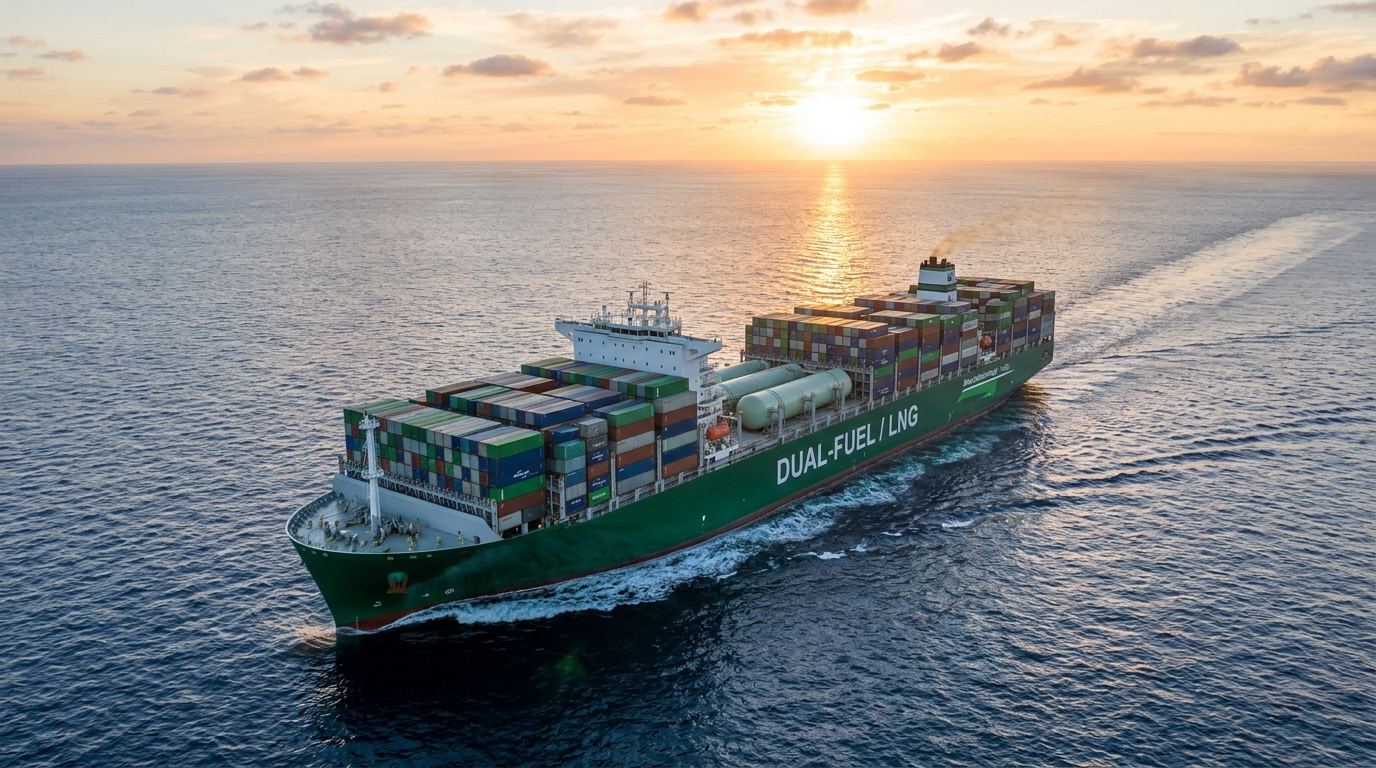
- Vessel Efficiency & Age: Modern ultra-large container vessels (ULCVs) equipped with air lubrication, modern bow designs, or dual-fuel engines generate lower emissions per container than older feeder vessels.
4. The Broader Global Picture: IMO Net-Zero 2050
Is this limited to Europe? Definitely not.
The International Maritime Organization (IMO)—the United Nations body regulating global shipping—has approved revised greenhouse gas reduction strategies aiming for net-zero maritime emissions by or around 2050, with checkpoints of reducing emissions by at least 20%–30% by 2030 and 70%–80% by 2040.
The IMO is finalizing its own Global Fuel Standard (GFS) and an international maritime GHG pricing mechanism. Regional schemes like the EU ETS are merely the frontrunners; within the next 3 to 5 years, global carbon levies are set to apply across every major ocean corridor, including transpacific, transatlantic, and intra-Asia routes.
5. What Shippers Must Do: 5 Practical Steps to Navigate Green Surcharges
Rather than treating emissions surcharges as an uncontrollable tax, proactive exporters and logistics managers can take deliberate steps to optimize their costs:
1. Separate Base Freight from Carbon Surcharges in RFQs
During tender and contract negotiations, insist on transparent cost breakdowns. Require freight forwarders and carriers to quote Base Ocean Freight, Bunker Surcharges (BAF), and EU ETS / Environmental Surcharges as distinct line items. This transparency protects you from inflated all-in rate cushions.
2. Audit Carrier Fuel & Routing Strategies
Vessels sailing direct services or utilizing newer, more fuel-efficient tonnage will naturally incur lower carbon penalties than multi-transshipment feeder routings on older vessels. Ask your freight partner about the carrier’s deployment strategy and whether services bypass unnecessarily circuitous loops.
3. Track and Report Scope 3 Upstream Logistics Emissions
Corporate buyers and institutional retailers in the EU and North America are increasingly subject to corporate sustainability reporting directives (such as the EU’s CSRD). Work with a forwarding partner that provides verified per-shipment Clean Cargo Working Group (CCWG) or GLEC Framework compliant carbon reports. Turning freight emissions data into an audited figure improves your ESG ratings.
4. Optimize Container Space and Packaging
Because carbon taxes and surcharges are assessed on a per-container basis (or per TEU/FEU), optimizing container payload utilization directly reduces your emissions cost per unit of product. Transitioning from LCL to FCL consolidations, redesigning carton palletization, or using high-cube equipment spreads the fixed ETS surcharge over more salable volume.
5. Evaluate Green Biofuel Book-and-Claim Programs
Many major carriers now offer “Biofuel / Mass Balancing” services that allow cargo owners to pay a voluntary green tariff to claim 100% certified CO₂ abatement via mass-balanced sustainable marine fuels. While this carries a premium, it can entirely offset compliance liability and count toward zero-emission contractual commitments with end customers.
The Seatrans Advantage
Decarbonization is no longer just an environmental talking point—it is reshaping routing economics, shipping contracts, and international pricing models.
At Seatrans Agencies, our clearing, forwarding, and ocean freight specialists provide complete invoice transparency, route optimization, and reliable supply chain advisory. We help you navigate shifting maritime tariffs, green surcharges, and customs documentation without surprise fees or unexpected delays.
Looking to streamline your international ocean freight and manage your global shipping costs? Contact Seatrans Agencies today to speak with our freight routing experts.