


Many businesses shipping goods from the USA to India often see higher bills. The reason is usually not a mistake or a hidden fee. It happens because they do not fully understand how shipping companies calculate the price. When you send goods internationally, the shipping charges from india to usa are based on two things.
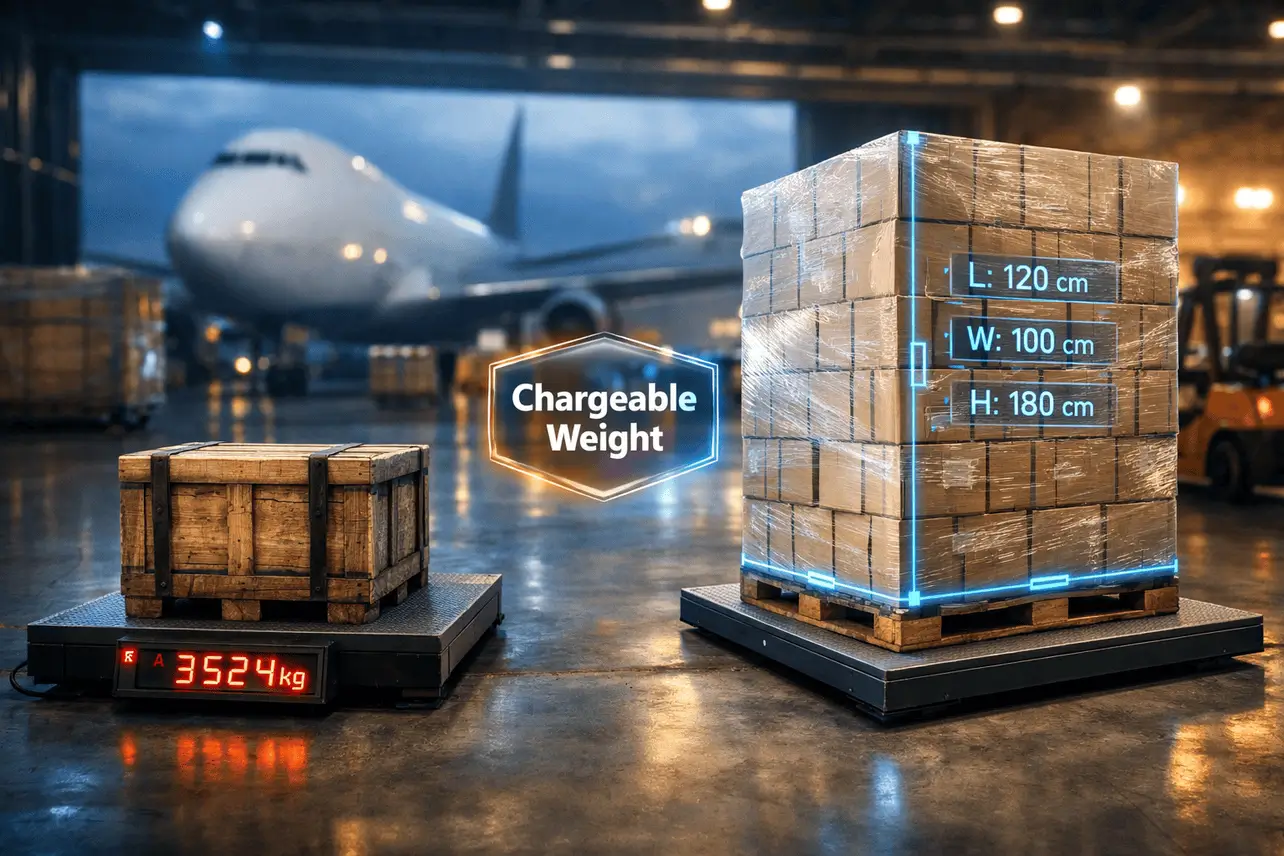
The Actual Weight or Volumetric Weight is used for pricing and the carrier will always choose the higher number of the two weights. This rule changes your total shipping cost from India to usa significantly and it decides if you save money or lose money on shipments. Learning this basic rule can help your business save thousands of dollars annually.
What Is Actual Weight in Shipping?
Actual Weight is simply the real physical weight of your package. It is what you see when you put your box on a scale. It is measured in kilograms or pounds depending on your preference. This is the easiest part of shipping to understand fully. If your box weighs 50 kg on the scale, the Actual Weight is 50 kg.
The size of the box does not matter for this measurement. For commercial shipments, Actual Weight becomes the Chargeable Weight when your items are heavy. Things like machine parts, metals, or heavy electronics usually fit this description well. However, this is only one part of how shipping rates from india to usa work.
Understanding Volumetric Weight and How It Works
Volumetric Weight, also known as Dimensional Weight, looks at space your package takes up. Shipping companies use this because space inside a plane is limited. A big box of cotton might weigh very little indeed. However, it takes up the same space as a heavy box. If carriers were only charged by weight, they would lose money on light boxes.
To solve this, carriers use a standard math formula for calculations. The industry standard for commercial air cargo follows the International Air Transport Association (IATA) rule that converts cubic centimetres to kilograms by dividing by 6,000.
However parcel and express couriers commonly use a smaller DIM divisor (for example 5,000 for many express services), which increases the calculated volumetric weight. Always check the exact DIM factor with your carrier and for the specific service you plan to use.
Formula for Air Freight: Volumetric Weight (kg) = (Length × Width × Height in cm) ÷ 6,000
Formula for Express Couriers: Volumetric Weight (kg) = (Length × Width × Height in cm) ÷ 5,000
Here is an example for businesses looking for cheap shipping from india to usa today. Imagine you are sending light clothes in a standard box. The box measures 50 cm × 40 cm × 30 cm total. However, it weighs only 5 kg on the scale. The math would be: (50 × 40 × 30) ÷ 5,000 = 12 kg total.
Even though the box only weighs 5 kg physically, the Volumetric Weight is 12 kg. The shipping company will charge you for 12 kg instead. This is a standard rule for companies offering services for india to usa shipping charges.
The Critical Rule: Chargeable Weight Determination
The weight that appears on your bill is called Chargeable Weight. The rule is simple: the carrier compares the Actual Weight and the Volumetric Weight. The Chargeable Weight is always the higher number of the two values. This rule exists so carriers are paid fairly for transport services. They need payment for both the weight and the space used.
If a shipment takes up a lot of space, it should cost more. This happens even if the package is light in physical weight. For exporters, this directly changes the india to usa shipping rates for every shipment. A large container might hold goods that are light but bulky. In this case, you will pay based on volume, not physical weight.
How Volumetric Weight Affects Your Shipping Cost from India to USA
This rule can make a big difference in your shipping cost from india to usa. Let’s look at two examples to see how it works properly.
Scenario 1 – Light but Big Shipment (Air Freight)
- Product: Computer monitors in standard packaging
- Actual Weight: 150 kg on the scale
- Dimensions: Big boxes taking up a lot of space
- Volumetric Weight: 500 kg calculated from the box size
- Chargeable Weight: 500 kg because 500 is bigger than 150
- Result: You pay for 500 kg on your final bill
If you only paid for the Actual Weight, it would be much cheaper. But because the shipment is big, the Volumetric Weight increases the price hugely.
Scenario 2 – Heavy and Small Shipment (Air Freight)
- Product: Heavy machine parts inside small boxes
- Actual Weight: 800 kg on the scale
- Dimensions: Small boxes with little wasted space
- Volumetric Weight: 200 kg calculated from the box size
- Chargeable Weight: 800 kg because 800 is bigger than 200
- Result: You pay for 800 kg on your final bill
In this case, the Actual Weight is higher, so that is what you pay. Heavy items are usually billed on their real weight only.
Volumetric Weight Impact on Different Shipping Modes
| Shipping Mode | Volumetric Calculation | Best For | Cost Impact |
| Air Freight | Divide by 6,000 | Fast, light shipments | High extra cost for big boxes |
| Express Courier | Divide by 5,000 | Small parcels, samples | Prices often go up by 20–40% |
| LCL Ocean Freight | 1 CBM = 1,000 kg | Mixed cargo loads | Medium impact on total cost |
| FCL Ocean Freight | Per Container price | Full loads | Low impact using flat fee |
Ocean shipping is a bit different from air freight calculations. For LCL ocean shipments carriers typically convert volume to weight using 1 CBM = 1,000 kg (1 metric ton) as a rule of thumb, and billing is by whichever is greater: weight or volume. That means a cargo occupying 1 CBM will commonly be billed as 1,000 kg even if the physical mass is much lower.
For FCL (Full Container Load), Volumetric Weight matters less than other factors. You pay a flat price for the whole container space. This is often the best way to get good shipping price from india to usa deals.
Real Pricing Examples: How Actual vs Volumetric Affects India to USA Rates
Express Courier Rates (DHL, FedEx, UPS):
- Small packets up to 5 kg typically cost around ₹6,800 total.
- This amount is approximately USD 80 in current rates.
- Larger packets of 10 kg typically cost around ₹9,900 total.
- This amount is approximately USD 116 in current rates.
- Heavy shipments of 100+ kg cost around ₹550 – ₹980 per kg.
These shipping from india to usa rates apply to the Chargeable Weight always. If your package is light but large, you will jump higher in price brackets.
Air Freight Rates (Bulk Shipments):
- Standard Air Freight costs $4 – $8 per kg depending on season.
- Again, this price is for Chargeable Weight only.
- A 200 kg shipment acting like 350 kg costs the same as 350 kg.
Ocean Freight LCL Rates:
- Price per CBM is typically $100 – $300 depending on ports.
- East Coast ports usually have different rates than West Coast ports.
- Extra charges add 13–25% of the base rate amount.
- If you ship 10 CBM of light goods, you pay for 10 CBM.
- This shows why knowing volume is key for india to usa shipping charges.
Cost Optimization Strategies for Volumetric Weight
Exporters can use smart methods to lower the effect of Volumetric Weight. These methods help reduce your shipping cost from india to usa significantly.
1. Use Better Box Sizes: Try to use boxes that fit your product perfectly every time. A product in a square box takes up less space. This is better than using a long, thin box shape. Packing tightly can reduce Volumetric Weight by up to 15%.
2. Remove Empty Space: Do not use too much filler like foam peanuts inside boxes. Use air pillows or paper instead for protection. This keeps the box size small while protecting goods well. Less empty space means a lower shipping price from india to usa.
3. Combine Your Shipments: If you have many small boxes going to one place, combine them. Put them together into one big shipment for better rates. This is called consolidation in the shipping industry. It usually leads to better rates and less wasted space.
4. Choose FCL Instead of LCL: If you have large amounts of goods over 15 cubic meters, switch modes. Switching to FCL (Full Container Load) might be cheaper for you. You pay one price for the box space. You do not have to worry as much about volume calculations this way.
5. Compress Your Products: If you are shipping clothes or soft items, squeeze them tight. Compressing these items can make the box much smaller. This lowers the Volumetric Weight and saves you money.
Hidden Charges Beyond Volumetric Weight
Knowing about Volumetric Weight is important for all exporters today. However, you must also watch out for extra fees increasing shipping from india to usa rates.
- Fuel Surcharge: This is an extra fee for fuel costs changing often.
- Peak Season Fee: This is extra cost when shipping is very busy.
- Remote Area Fee: This is charged if the delivery address is far away.
- Oversized Cargo Fee: This is a large fee for items too big for standard equipment.
- Customs Fee: This is money paid for clearing your goods through customs.
These fees can add 25–40% to your final bill amount. A base price of $2,000 can easily become $2,800 after these extras.
Conclusion
Volumetric Weight changes how shipping charges from india to usa are calculated today. It is not a trick, but a standard industry rule. Understanding it helps you plan your shipments better from the start. Heavy products are charged by Actual Weight, while light and big items use size.
To manage your shipping cost from india to usa, you must do three key things. Measure your boxes carefully, combine shipments when you can, and pick the right shipping mode. Small changes in how you pack can save a lot of money.
Don’t let volumetric weight inflate your budget unnecessarily. For tailored rate optimization and consolidation services contact Sea Trans Agencies, a freight forwarder that can help you compare carrier DIM rules, consolidate shipments and choose the lowest-cost mode for your route.