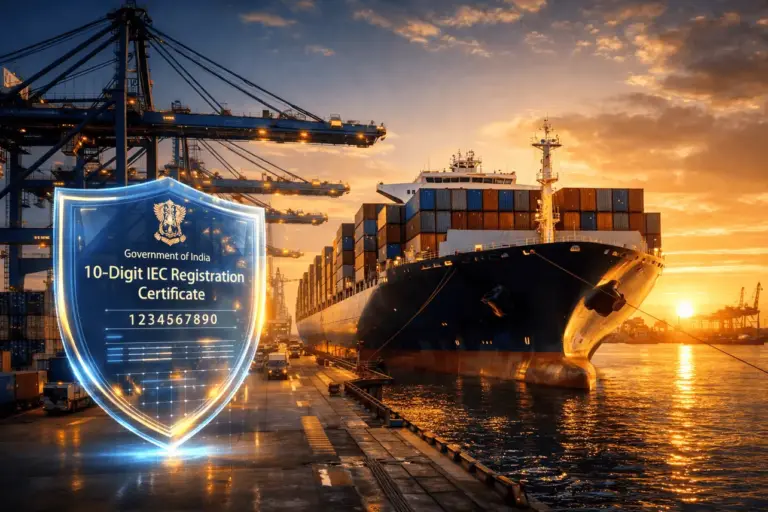


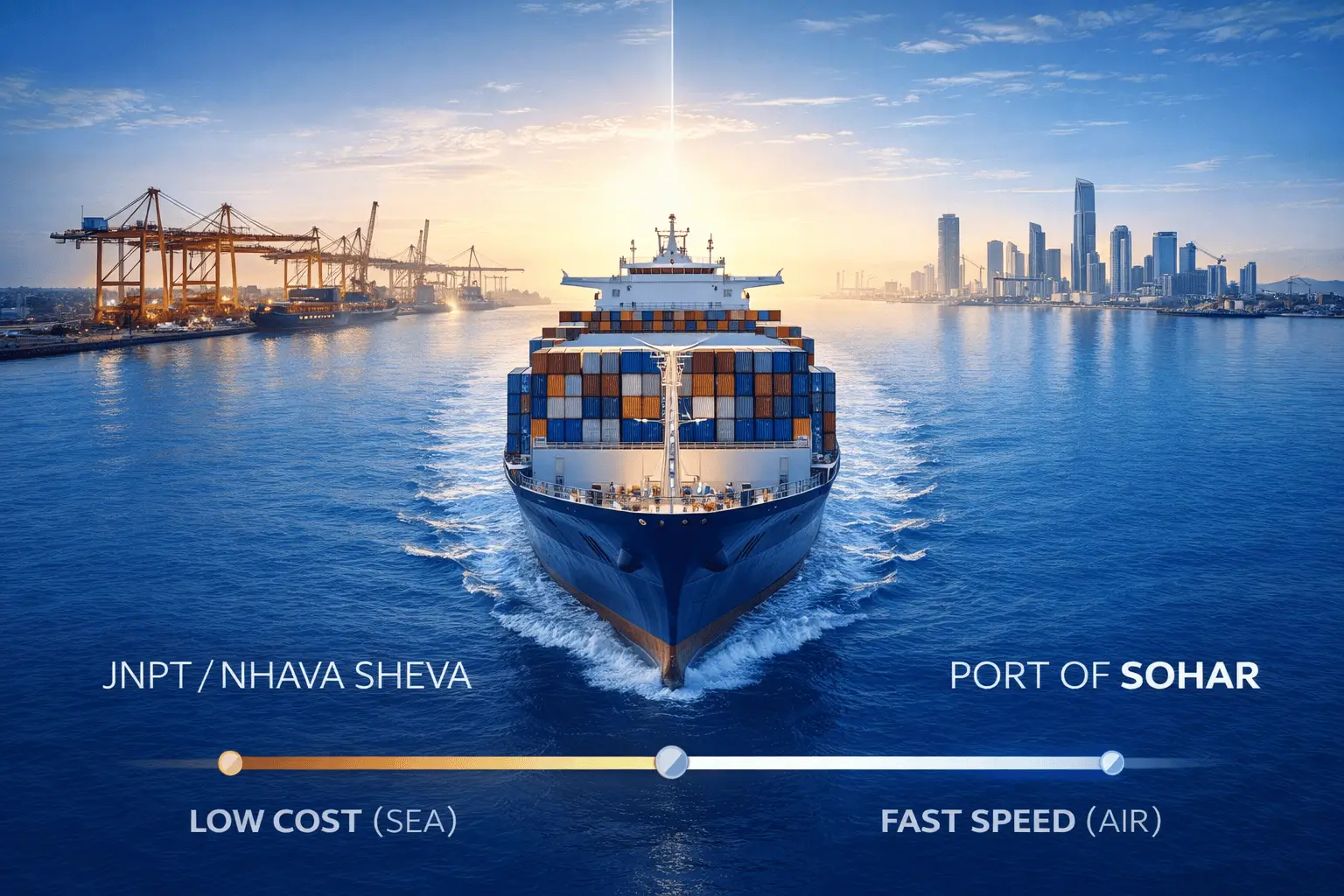
Shipping from India to Oman by sea presents several challenges for small and medium enterprises. Many SMEs struggle with confusing documentation requirements, leading to customs delays that can cost $200 to $500 per day. Different freight forwarders give different quotes. This makes cost planning hard. Complex documents like IEC codes, certificates of origin, and shipping bills confuse new exporters.
However, the India-Oman shipping route offers affordable solutions when you know the process. Sea freight is typically several times cheaper than air freight with ships taking 17 to 25 days and rates starting from $280. This comprehensive guide provides a practical checklist for managing quotes, schedules, and documentation, helping small businesses ship confidently and avoid costly mistakes.
Why India-Oman Sea Freight Works for SMEs
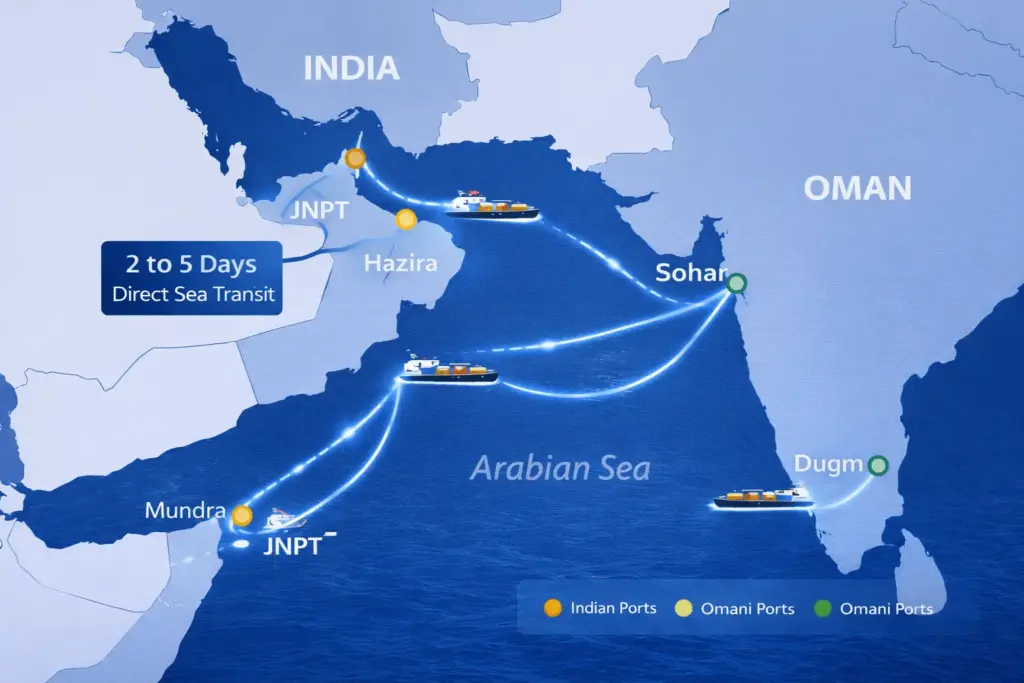
Many small businesses prefer sea freight because it is far cheaper than air freight while still being reliable for commercial trade. This route connects Indian manufacturers directly to Oman’s growing industrial and retail markets with regular container services. Ships operate frequently from major Indian ports such as JNPT (Nhava Sheva), Mundra, and Hazira to Omani ports like Sohar and Salalah.
On direct services, the actual sea voyage often takes only 2 to 5 days, though door-to-door delivery may take longer because of inland transport, customs clearance, and port handling. SMEs can choose between Full Container Load (FCL) and Less than Container Load (LCL) options depending on shipment size. This makes the route flexible, affordable, and suitable for textiles, machinery, auto parts, chemicals, consumer goods, and general cargo.
Main Shipping Routes from India to Oman
Key Indian Ports for Oman-Bound Cargo
Three main ports handle most sea freight from India to Oman. JNPT (Nhava Sheva) is near Mumbai. It is India’s largest container port. It has frequent ships to Oman. Mundra Port is in Gujarat. It has deep water for big ships. Ships reach Sohar from here in just 17 days. Hazira Port is near Surat. It is another key gateway on the west coast. These ports have weekly schedules. This gives SMEs many options. Freight forwarders at these ports help small businesses.
Primary Oman Ports for Indian Imports
Cargo from India arrives at three main ports in Oman. Sohar Port is 200 kilometers from Muscat. It is the main entry for industrial goods. Salalah Port is in the south. It has a free zone. It handles cargo going to other places. Duqm Port is a new facility. It offers special economic zone benefits. SMEs should choose a port near their final destination. They should also check for free zone benefits.
Transit Times and Sailing Schedules
Typical Journey Durations
The direct sailing time from India to Oman is usually 2 to 5 days, depending on the port pair and shipping line. For example, Mundra to Sohar is commonly among the fastest services, while JNPT to Salalah may take slightly longer.
However, SMEs should plan 7 to 19 days for total door-to-door delivery, which includes:
- Trucking from factory to port
- Customs processing in India
- Vessel loading time
- Discharge at Omani port
- Customs clearance in Oman
- Final delivery to warehouse
During the monsoon season, delays of 2 to 4 days can occur due to weather or port congestion, so exporters should build this buffer into their schedule.
Frequency of Departures
Major shipping lines offer weekly and sometimes multiple weekly departures between India and Oman. Busy ports like Mundra and JNPT typically have two to four sailings per week.
During peak trade seasons, carriers often deploy extra vessels. SMEs are advised to book container space 7 to 10 days in advance to secure availability and avoid last-minute rate increases.
Cost Structure and Getting Accurate Quotes
What Affects Shipping Costs
Shipping costs depend mainly on container size, cargo weight, season, and fuel prices. As a broad market indication:
- 20-foot container (FCL): often ranges from $400 to $1,700, depending on demand, carrier, and port.
- 40-foot container (FCL): usually higher and varies widely based on fuel surcharges and congestion.
If goods are hazardous, oversized, or temperature-controlled, additional charges apply.
For small shipments, SMEs can use LCL (shared container). LCL costs more per cubic meter but avoids paying for a full container when cargo is limited. Exporters should also budget for port handling charges of approximately $150 to $300 at origin and destination combined.
How to Request SME-Friendly Quotes
To get accurate pricing, provide forwarders with:
- Cargo weight and volume
- Product type and HS code
- Pickup location in India
- Preferred Oman port
Always request an all-inclusive quote that clearly lists:
- Inland transport
- Ocean freight
- Port handling
- Documentation
- Customs clearance
Compare at least three different freight forwarders before finalizing. Since ocean rates change frequently, check the quote validity date and confirm space availability before booking.
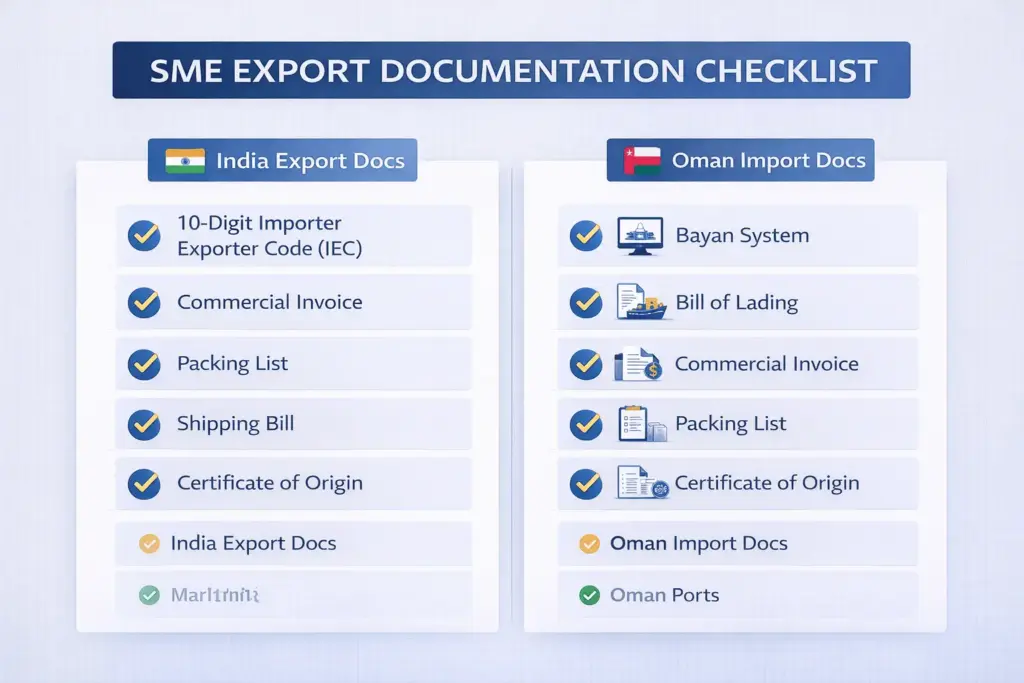
Essential Documentation Checklist for SMEs
Export Documents from India
- Importer Exporter Code (IEC): You need a 10-digit IEC issued by India’s Directorate General of Foreign Trade (DGFT) to export goods. In most cases, IEC can be obtained the same day through online application using your PAN card, though occasional manual verification may take longer.
- Commercial Invoice: This lists the buyer and seller. It details product quantity and value. Customs uses this to calculate taxes.
- Packing List: This describes the contents of each package. It lists weight and size. Customs checks this to verify cargo.
- Shipping Bill: File this form online through ICEGATE. Do this before cargo leaves India because it needs details from your invoice.
- Certificate of Origin: This proves your goods were made in India. Get it from a chamber of commerce, It helps you get correct tax rates in Oman.
Import Documents for Oman
- Bill of Lading: The shipping line gives you this document that proves you own the goods. You need it to claim cargo in Oman.
- Customs Declaration: Submit this through Oman’s “Bayan” system. Include your invoice and bill of lading.
- Import Permit: Some goods need special permits. Check if your products need this. Do this before you ship.
Step-by-Step Shipping Process
Pre-Shipment Preparation
First, get your IEC code. Register with Indian customs. Create accurate invoices and packing lists. These must match your cargo exactly. Book space with a forwarder 7 to 10 days early. Arrange a truck to the port. Pack your goods safely. Get your certificate of origin. Submit your shipping bill online and wait for approval.
Customs Clearance in India
Customs officers review your documents. They may decide to physically inspect your cargo to check for safety compliance. You must pay any applicable export duties before the process moves forward. Customs will issue a Let Export Order (LEO) which allows your cargo on the ship. Your forwarder then moves the container to the port for final loading. Ensure all paperwork is correct because simple errors can cause significant delays. These delays often cost businesses between $200 and $500 per day in fees.
Oman Customs and Final Delivery
Once cargo reaches Oman, your customs broker files a declaration in the Bayan system (Oman’s official customs platform). You must submit:
- Original Bill of Lading
- Commercial Invoice
- Packing List
- Certificate of Origin
Import duties depend on the product’s HS code, so the rate is not the same for all goods. Some items may qualify for preferential treatment under India–Oman trade arrangements, while others may be subject to standard duties.
After duties and port fees are paid, goods can be released for delivery. With complete documentation, clearance usually takes 2 to 4 working days.
Common SME Challenges and Solutions
Documentation Errors
Paperwork mistakes cause 60% of delays. Match product details on all forms. The invoice, packing list, and shipping bill must agree. Use simple product descriptions. Avoid hard technical words. Check the receiver’s name and address.
Cost Overruns
Unexpected fees hurt profits. Ask for detailed quotes that list every charge. Plan for customs duties based on the product’s HS code. Include port fees of $150 to $300. Add documentation costs of $50 to $100. Watch for currency changes. Book shipments early. This avoids busy season fees. Digital platforms help you see real costs.
Transit Delays
Port congestion and bad weather can slow shipments, especially during peak seasons. SMEs should add 3 to 5 extra days to their planned delivery timeline as a buffer. Use online vessel tracking tools to monitor your shipment in real time and stay in regular contact with your freight forwarder. For urgent consignments, keep air freight as a backup option.
Tips for Smooth Shipping Operations
Choosing the Right Freight Forwarder
Pick an experienced freight forwarder. They should know the India-Oman route. Check for memberships in groups like FIATA or IATA. Read reviews from other businesses and ensure they offer online tracking. They should give you a document checklist. They should explain customs simply.
Insurance and Risk Management
Marine cargo insurance is strongly recommended for shipments valued above $5,000. Typical premiums range from 0.3% to 0.5% of cargo value, depending on risk and product type. Take clear photographs of goods before packing and keep all shipping documents and emails. These records help speed up any future insurance claims.
Conclusion
Shipping from India to Oman by sea is affordable. You must understand the whole process. Success relies on accurate documents and realistic schedules. You must manage costs and choose experienced partners. Use this checklist to organize your shipping operations. It helps you avoid common errors. It reduces unexpected costs that hurt profits. Proper preparation helps your business grow in the Oman market.
Ready to ship your cargo from India to Oman? Partner with Sea Trans Agencies, one of the biggest logistics companies in India and worldwide. As a leading cargo forwarder across any port in the world, Sea Trans Agencies provides end-to-end shipping solutions tailored for SMEs. Get transparent quotes, expert documentation support, and reliable delivery schedules for your India-Oman shipments.
Analyse this article, and give me 3 image suggestions. One of them should be Feature image and the rest of 2 are infographics for different sections.
Give me images suggestions like an image prompt. Keep in mind these images are related to the freight forwarding and shipping industry.