
Entering international markets can change the scale of your business very fast. To deal with customs, banks, and export benefits, you must first secure the right legal registration. The key permission you need is the Importer Exporter Code, often called IEC or import export license india.
The good news is that the process is fully online and the official fee is low for 2025–2026. This guide explains the exact costs and a clear step‑by‑step method so you can apply with confidence.
What Is an IEC and Why Your Business Needs It
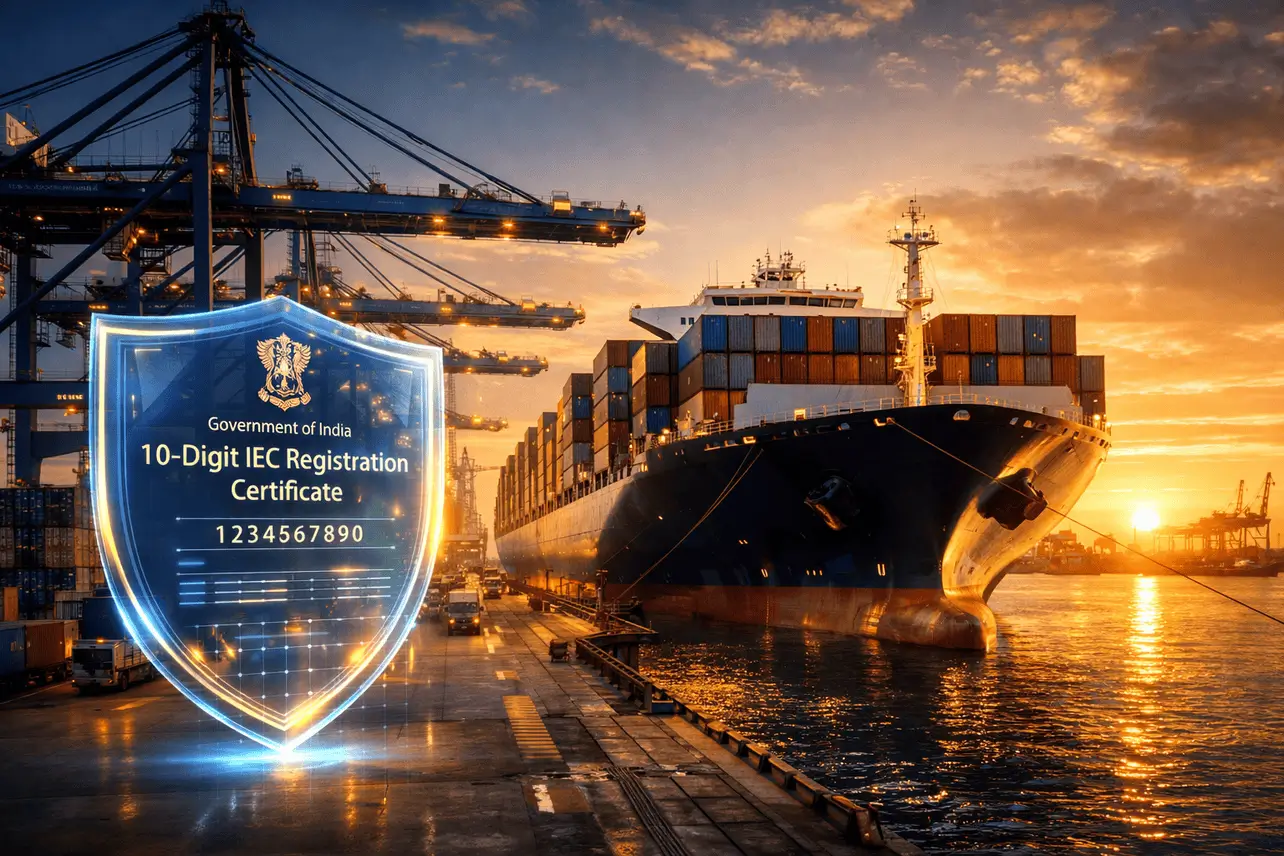
The Importer Exporter Code (IEC) is a 10‑digit registration number issued by the Directorate General of Foreign Trade (DGFT). It works as your identity for all import and export activities from India.
You need an IEC if you:
- Import goods or services for commercial use
- Export goods or services and receive payment in foreign currency
- Want to claim export incentives, duty refunds, or other trade benefits
Both individuals and entities like proprietorships, partnerships, LLPs, private limited companies, and public companies can apply. Once granted, the IEC has lifetime validity, but you must keep it updated every year to keep it active.
Import Export License Cost in India in 2025–2026
Business owners often ask about import export license costs before they plan their budget. The official structure is simple and transparent for 2025–2026.
Standard IEC Registration Fee
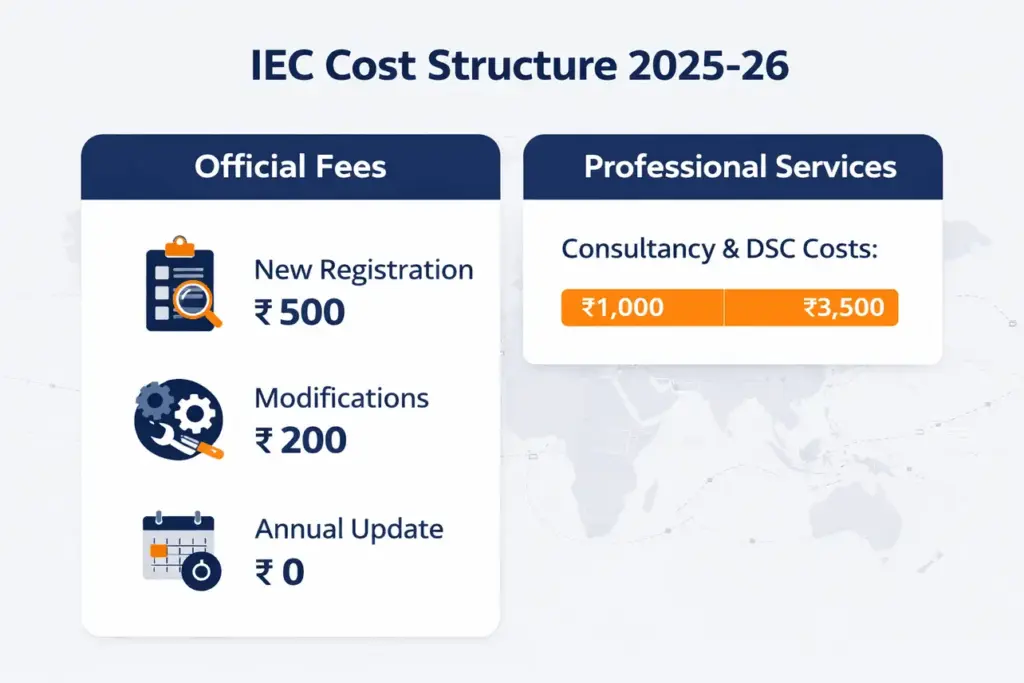
For most businesses, the IEC itself is the only license needed to handle regular import and export. As of 2025, the government fee for a fresh IEC application is:
- New IEC registration (all entity types): ₹500
You pay this fee once on the DGFT portal during the online application. There is no separate DGFT charge for renewal every year, only for certain changes.
Other DGFT Fees Linked to IEC
You should also factor in small possible charges over the years:
- Modification or update of IEC details: ₹200 per request (for change in address, director, bank details, etc.)
- Duplicate Certificate: ₹200 (Rarely needed, as you can download your IEC PDF for free from the portal anytime)
- Annual IEC update between April and June each year: ₹0 (no government fee)
The annual update is mandatory. If you skip it, DGFT can deactivate your IEC until you update it.
Export License Cost for Restricted Items
Some products fall under “restricted” or “SCOMET” categories, such as controlled chemicals, sensitive technologies, or certain defense‑linked items. For these, you need a separate export or import license in addition to IEC.
Current indicative fees are:
- Application for export license for restricted / SCOMET items: ₹1,000 per application
- Application for import license for restricted items: usually ₹1,000 or more, linked to CIF value (roughly ₹1 per ₹1,000 value, capped at ₹1 Lakh with defined minimum and maximum limits)
This is where many users search for “export license cost” because they deal with specific controlled goods. For most normal products, only the base IEC fee of ₹500 applies.
Professional and Service Costs in 2025–2026
Government fees are low, but many businesses hire consultants, CAs, or facilitation agencies. Typical professional charges in 2025 for IEC:
- Professional fees: ₹1,000–₹3,500 depending on city, volume, and support.
In addition, you may spend on:
- Document collection and scanning
- Internal admin time
- Coordination with your bank or customs broker
Earlier, applicants often had to buy a separate Digital Signature Certificate (DSC). For Proprietors, Aadhaar e-sign is often sufficient. However, Partnerships, LLPs, and Private Limited Companies usually require a Class 3 Digital Signature Certificate (DSC) token for the authorized signatory.
How to Get Import Export License in India: Step‑by‑Step Guide
This is the core process that answers how to get import export license in india? Or how to make import export license in India? in a clear sequence.
Step 1: Decide the Applicant Type and Structure
Decide in whose name you will apply:
- Individual (proprietor)
- Proprietorship firm
- Partnership firm or LLP
- Private limited or public company
- Trust, society, or government entity
Make sure PAN, bank account, GST registration (if any), and address proof match this entity. Banks and customs will rely on this data.
Step 2: Collect All Required Documents
Keep digital copies ready in PDF or JPEG format. Common documents include:
- PAN card of individual or entity
- Aadhaar card of individual or key person (for OTP e‑sign)
- Business address proof (electricity bill, rent agreement, property tax receipt, etc.)
- Cancelled cheque or bank certificate with entity name, account number, and IFSC
- Incorporation certificate, partnership deed, or firm registration (if applicable)
- Active email ID and mobile number for OTPs
Check that names, dates of birth, and addresses match across records. Mismatch is a frequent cause of delay.
Step 3: Create Login on the DGFT Portal
Go to the official DGFT website: https://www.dgft.gov.in
- Click “Register” and fill basic details
- Verify email and mobile using OTP
- Set a strong password and complete registration
After this, log in with your new username and password. This account will hold your IEC and future applications.
Step 4: Start IEC Application (ANF 2A)
Inside the portal:
- Go to Services → IEC Profile Management → Apply for IEC
- The system opens the online IEC form, also called ANF 2A
Fill in:
- Applicant type and PAN
- Business name, trade name, and constitution
- Registered office address and branch details (if any)
- Bank account details used for export and import
- Director / partner / proprietor details, including DIN or Aadhaar
- Preferred sectors, products, or HS code groups (basic level)
Review each field carefully. Data here feeds customs, bank KYC, and export promotion schemes.
Step 5: Upload Documents and Verify Identity
Next, upload the supporting documents:
- PAN
- Address proof
- Bank details
- Entity registration papers
Then complete authentication by:
- Aadhaar‑based OTP e‑sign, or
- Valid Class 3 DSC (mandatory for many companies and LLPs)
The system links your IEC profile with your PAN and identity records.
Step 6: Pay the IEC Fee and Submit
On the payment page:
- Confirm the government fee of ₹500 for new IEC
- Choose payment mode: net banking, debit card, credit card, or UPI
- Complete payment and wait for the success message
Once paid, the application goes for automated processing. In most clean cases where PAN and bank details match perfectly, the IEC is generated instantly and sent to the registered email ID as a soft copy certificate.
Step 7: Download and Use Your IEC
After approval:
- Log back into the DGFT portal
- Go to “My IEC” or “Print IEC”
- Download and save the PDF certificate
Share the IEC with:
- Your bank, to set up export and import accounts
- Customs broker or freight forwarder
- Marketplaces and logistics partners that need IEC mapping
How to Get Export License in India for Restricted Items
Many traders ask how to get an export license in India and confuse it with IEC. The IEC is your base registration. A separate export license applies only if your product falls in a restricted or SCOMET category.
For such cases:
- Identify product categories using HS code and check DGFT schedule and SCOMET list.
- Confirm restriction status and conditions with a trade consultant or DGFT helpdesk.
- Apply on DGFT portal under the export license section for restricted items.
- Upload detailed documents, such as product specs, end‑use statement, end‑user details, and any security clearances.
- Pay the export license cost, which usually starts from ₹1,000 per application for restricted items.
- Wait for approval, as these applications involve higher scrutiny and may take longer than IEC.
You will still use the same IEC number, but customs will also check the specific license for that product and shipment.
How to Renew IEC Code and Keep It Active
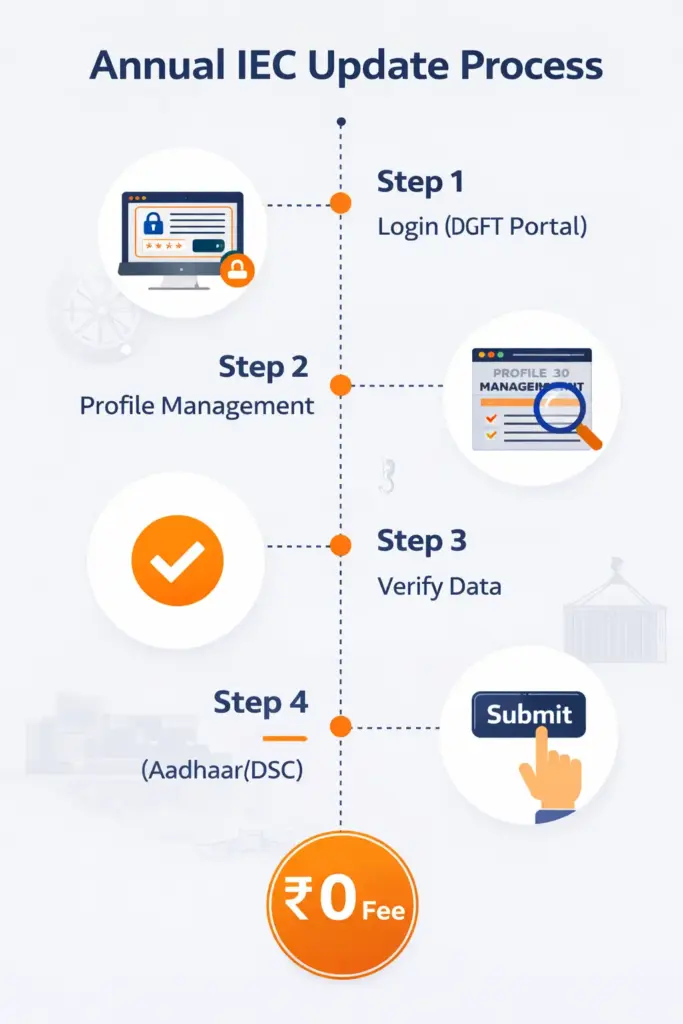
Many business owners don’t know how to renew iec code because DGFT now requires a yearly update. From FY 2021–22 onward, every IEC holder must update or confirm details every year between 1 April and 30 June.
The process is simple:
- Log in to the DGFT portal with your credentials.
- Go to Services → IEC Profile Management → Update/Modify IEC.
- Check all existing details in the IEC profile.
- Update any change in address, directors, bank, or contact details.
- Submit using Aadhaar OTP or DSC e‑sign.
There is no government fee for this annual IEC update window. If you skip it, DGFT can deactivate your IEC. You then cannot file new shipping bills or import documents until you reactivate by completing the pending update.
Practical Tips to Control Import Export License Cost
Here are simple ways to keep your import export license cost low over 2025–2026:
- Finalise your business structure before applying, so you avoid repeat modifications.
- Use Aadhaar e‑sign where allowed to save on extra DSC cost for individuals.
- Keep all records consistent across PAN, GST, bank, and address proof. This prevents rejection and re‑filing.
- If your product range is simple and you are comfortable with online forms, apply yourself and save on professional fees.
- For complex group structures or restricted items, hire an expert once and get the structure right from the start.
These steps save time, reduce error chances, and help you move faster into cross‑border sales.
Conclusion
Ready to unlock international markets? Getting your IEC is simpler and more affordable than you think. It costs just ₹500 for registration and has zero annual fees. With the right documentation and process, you could have your approval in hand within days, not weeks.
Whether you’re ready to handle the process yourself or prefer expert guidance, the path to global trade starts with one clear decision. If you’d like professional support to ensure everything runs smoothly, Sea Trans Agencies has helped hundreds of businesses navigate their IEC applications with confidence, ensuring no surprises and no delays.