
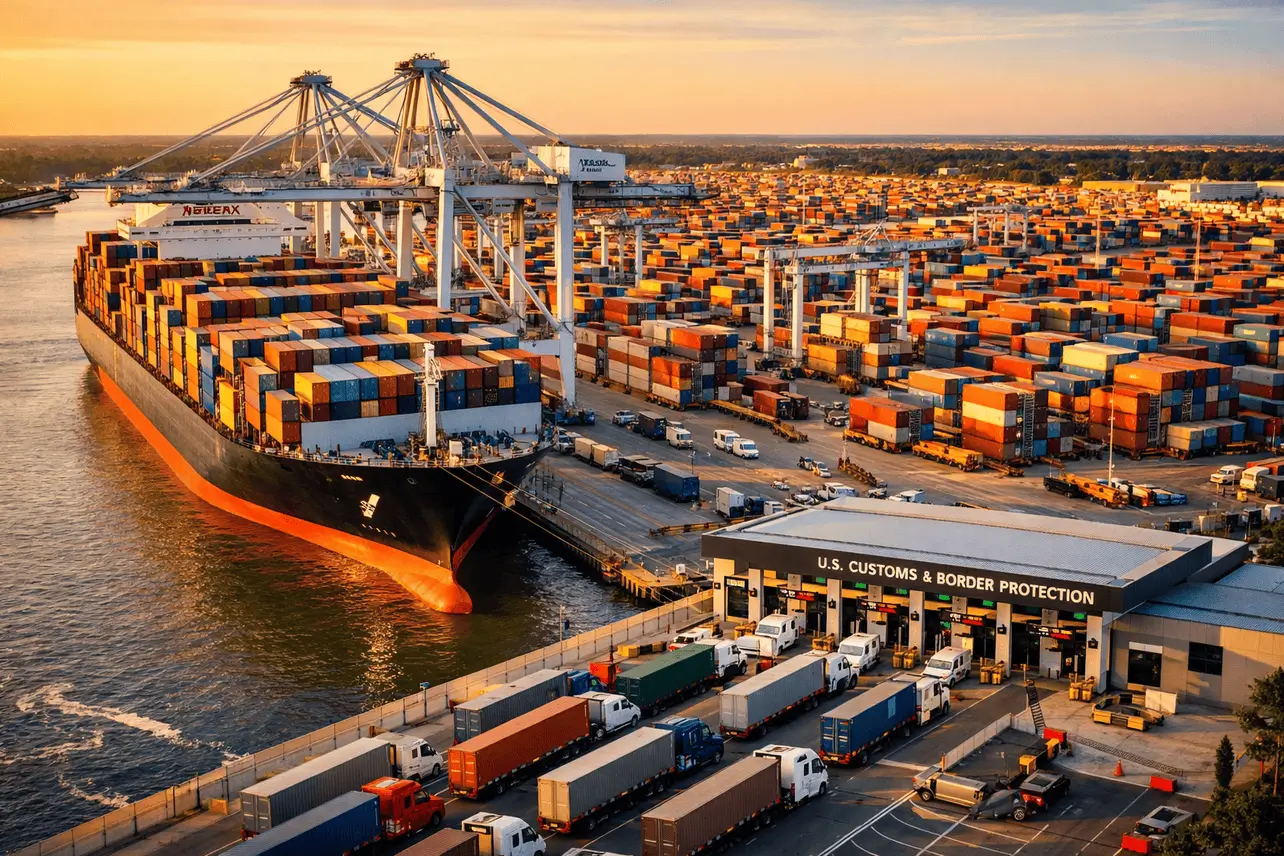
Shipping goods to America involves more than ocean transit. Customs clearance directly affects when your products reach customers and how much you spend on storage. Different ports in the USA east coast process cargo at vastly different speeds. While some facilities clear containers in under 24 hours, others take several weeks for the same cargo type.
Understanding clearance speeds at each east coast port in the USA helps you choose wisely, plan shipments strategically, and avoid expensive delays. The right port decision saves thousands in fees and accelerates your supply chain.
What Customs Clearance Means for Your Shipment Speed
Customs clearance is how U.S. Customs and Border Protection (CBP) checks and approves goods entering the country. They review your papers, inspect cargo if needed, collect taxes, and release containers for pickup. When this process moves fast, you pay less in storage fees and your products reach customers sooner.
How the Five-Step Process Works
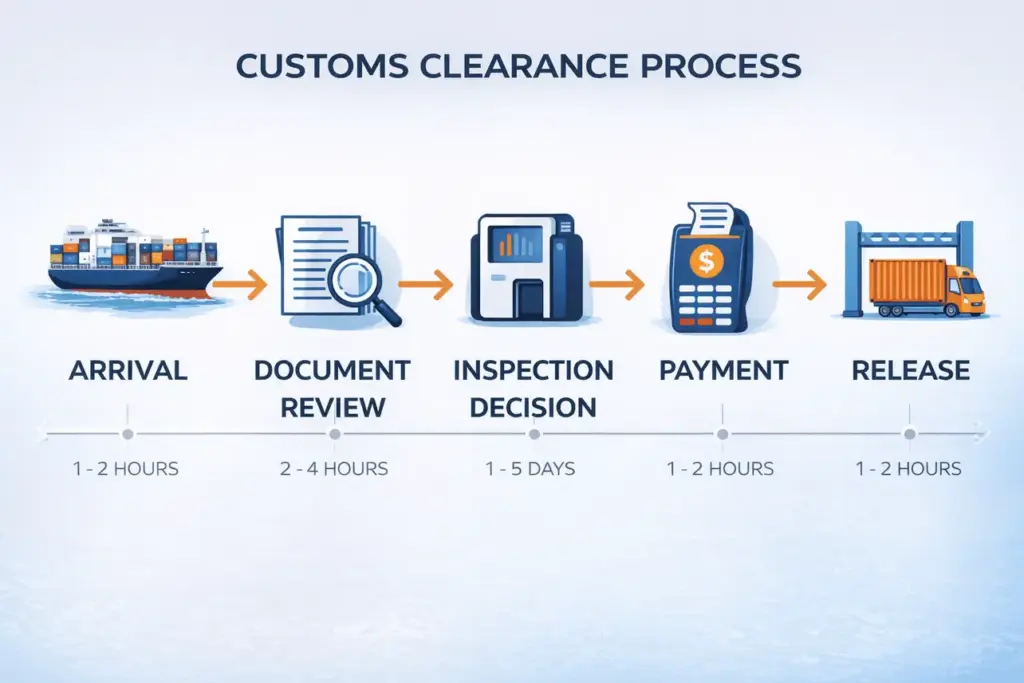
Customs clearance follows five simple steps:
- Arrival: Your container gets to the port
- Document Review: CBP checks your invoice, packing list, and shipping papers
- Inspection Decision: CBP decides if they need to physically check your cargo
- Payment: You pay any taxes within 15 days
- Release: CBP lets you pick up your cargo
Each step adds time to how long your container waits at the port.
Major East Coast Sea Ports in USA and Their Locations
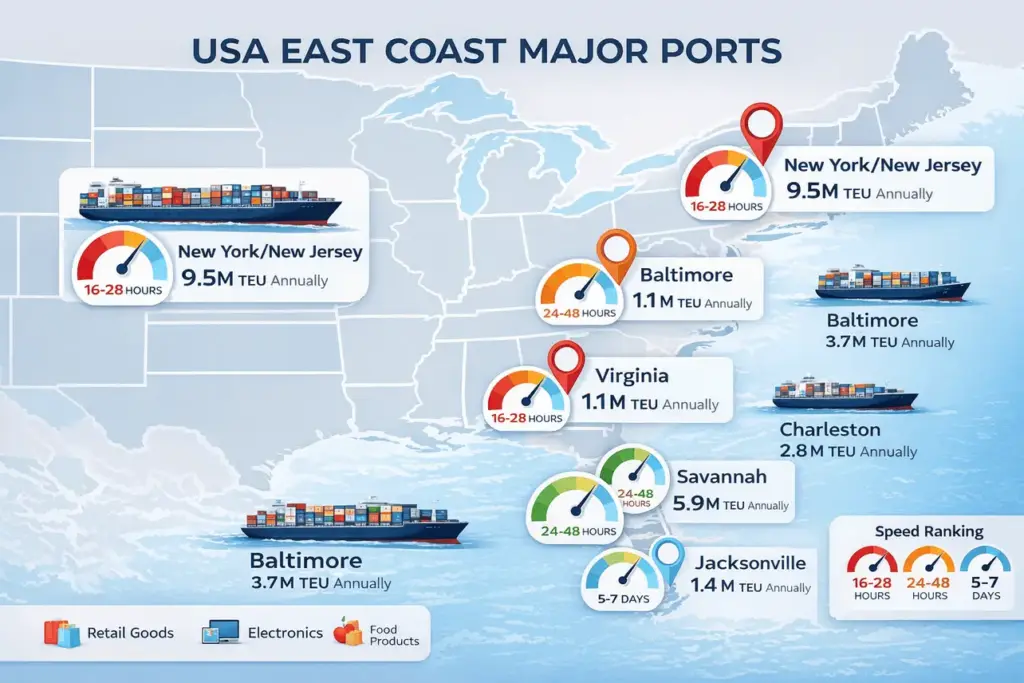
The list of east coast ports in the USA has seven main container terminals. These ports receive most cargo from Europe, Asia, and the Middle East. The big ones are Port of New York and New Jersey, Port of Savannah, Port of Virginia (Hampton Roads), Port of Charleston, Port of Baltimore, Port of Jacksonville, and Port of Boston. All ports follow the same federal rules, but they work at different speeds because of their equipment, crowding, and facilities.
Port of New York and New Jersey: America’s Busiest East Coast Gateway
The Port of New York and New Jersey handles more containers than any other East Coast port, moving 9.5 million TEUs every year. It processes complicated cargo like clothing, electronics, and other products. More variety means more checks and longer wait times.
Processing Speed for Regular and Inspected Cargo
Normal shipments that pass paperwork checks without physical inspection clear in 24 to 48 hours. But containers picked for examination take 3 to 7 days. The port has inspection areas right on the terminal, which makes checks faster than sending cargo to outside locations.
Why Some Cargo Faces Delays Here
The port checks 12 to 15 percent of containers because of high volume. Some cargo gets extra attention:
- Clothing and shoes from China
- Electronics and everyday products
- Shipments with missing papers
- Late Importer Security Filing (ISF) submissions
Late ISF filings cost up to $10,000 in fines. Wrong or missing product codes also create delays.
Port of Savannah: Fastest Customs Clearance on the East Coast
The Port of Savannah is now the most efficient container port on the East Coast, handling 5.9 million TEUs each year. The Garden City Terminal is North America’s biggest single container terminal and uses automatic systems that move cargo faster than old methods.
Record-Breaking Processing Times
Savannah clears good shipments in just 16 to 28 hours, making it the fastest among major east coast ports in the USA. Even cargo picked for deep inspection clears in only 3 to 5 days. Less crowding than New York helps create these faster times.
Why Savannah Moves Cargo Faster
The port works great with store goods, car parts, and everyday products. Strong train connections move 42 percent of containers by rail. This cuts down terminal crowding and gets your containers moving inland fast. Companies shipping to Southeast areas save major storage money here.
Port of Virginia: Advanced Technology Meets Deep Water Capacity
The Port of Virginia (Hampton Roads) moved 3.7 million TEUs in fiscal year 2022. The port spent nearly one billion dollars upgrading facilities, making it the most high-tech port on the East Coast.
Deep Harbor Advantages for Schedule Reliability
Virginia has the deepest harbor on the U.S. East Coast. This lets the biggest container ships dock without waiting for high tide. Ships arrive on time, which means fewer delays and more reliable customs timing.
Consistent 24 to 48-Hour Clearance Windows
Customs clearance at Virginia takes 24 to 48 hours for good cargo. Better equipment and less crowding create steady processing speeds. Strong train connections through Norfolk Southern Railway and CSX Transportation move cleared containers inland fast.
Port of Charleston: Deep Draft and Modern Operations
Charleston Port handled 2.8 million TEUs in 2022 and now has the deepest harbor on the East Coast at 52 feet. This depth lets big container ships dock no matter what the tide is doing.
Efficient Clearance with Lower Exam Rates
Charleston gives efficient customs clearance compared to older ports. The port has:
- Fewer inspection needs for good cargo
- Fast ship docking from recent upgrades
- Less crowding than northern East Coast ports
- Inland port connections at Greer and Dillon
Strategic Access to Interior Markets
The port serves Midwest areas and the Carolinas well. South Carolina’s easy business rules and modern work create an efficient gateway with fewer checks than busier northern ports.
Port of Baltimore: Processing Delays from Older Infrastructure
Baltimore Port uses older equipment compared to updated East Coast ports. Regular cargo takes 5 to 7 days to clear, going past 10 days during busy seasons. Old customs methods need multiple rounds of paper checking by hand.
Extra Time for Food and Cosmetics
Products like food and cosmetics face tough rules in Baltimore. These items need detailed ingredient reports and health certificates. Testing samples in labs during checks adds major time to clearance.
Higher Costs from Extended Processing
Delays at Baltimore increase your costs. Higher storage and container fees combine with slow customs work. Small yard space creates crowding that slows cargo handling more. Importers with time-sensitive products usually pick Savannah or New York instead.
Port of Jacksonville: Growing Efficiency for Florida Markets
Jacksonville (JAXPORT) is Florida’s biggest container port with a 47-foot deep channel. The port works with open ship windows seven days each week. Two-way ship traffic and smooth operations keep vessels on time.
Competitive Speed and Market Access
Jacksonville offers good clearing times in the 24 to 48-hour range for standard good cargo. The port gives quick access to Southeast and Midwest areas through train connections. Recent facility improvements keep crowding lower than northern East Coast ports.
What Determines Clearance Speed at East Coast Ports in USA
Several key things control how fast your cargo clears customs at any port.
Complete and Accurate Documentation
Paper quality is the most important thing. Missing documents, wrong product codes, or mismatched invoice details trigger CBP stops. Sending complete, correct paperwork before your ship arrives lets CBP start working while your ship is still at sea.
Importer Security Filing Requirements
The Importer Security Filing (ISF), also called “10+2,” must be filed at least 24 hours before your container loads at the foreign port. Late or wrong ISF submissions create penalties and processing stops. This early filing helps CBP find risky cargo before arrival.
Cargo Type and Inspection Probability
What you ship affects how likely inspections are. These types face more checks:
- Clothing and shoes
- Electronics and everyday goods
- Food and cosmetics
- Products from China and some countries
Goods from certain places get extra checking for tax rules and trade laws.
Port Technology and Congestion Levels
Port equipment directly impacts clearance speed. Places with modern automatic systems process containers faster. Ports with worker shortages or old equipment move cargo slower. Terminal crowding also limits access to CBP inspection areas, making overall wait time longer.
Proven Ways to Speed Up Customs Clearance
Submit Documents Before Vessel Arrival
File entry papers 24 to 48 hours before your ship arrives. Early filing lets CBP work on paperwork while your ship is at sea. This saves 2 to 3 days of processing time. Early filing is the best single way to speed clearance.
Use Correct Product Classifications
Right product codes and complete descriptions stop automatic holds. Unclear descriptions or wrong codes trigger CBP review. If you’re not sure about your product’s code, ask for a Binding Tariff Information ruling from CBP before shipping.
Work with Experienced Customs Brokers
Expert customs brokers know each port’s methods and have relationships with local CBP officers. They understand which cargo types get extra attention at each port. Brokers also handle ISF filings correctly to avoid fines that delay release.
Choose the Right Port for Your Cargo
Match your cargo type to port strengths. Time-sensitive store goods clear fastest through Savannah. Regular cargo moves well through Virginia and Charleston. Special cargo needing extra rules needs careful planning no matter which port you pick.
Speed Comparison: East Coast Ports in USA Performance Data
| Port | Annual Volume | Standard Clearance | With Inspection | Best Used For |
| New York/New Jersey | 9.5M TEUs | 24-48 hours | 3-7 days | High-volume Asia-Europe trade |
| Savannah | 5.9M TEUs | 16-28 hours | 3-5 days | Retail goods, Southeast markets |
| Virginia | 3.7M TEUs | 24-48 hours | 3-5 days | Large vessels, transatlantic trade |
| Charleston | 2.8M TEUs | 24-48 hours | 3-5 days | Interior Southeast, Carolinas |
| Jacksonville | Moderate | 24-48 hours | 3-5 days | Florida markets, growing routes |
| Baltimore | Moderate | 5-7 days | 10+ days | Break-bulk, specialized cargo |
Conclusion
Customs clearance speed changes greatly across different ports in the USA east coast, going from Savannah’s best-in-class 16-hour processing to Baltimore’s long 7-day timelines for standard cargo. The port of Savannah leads the East Coast with modern automatic systems and very little crowding.
The Port of New York and New Jersey handles the most volume but needs longer processing times. Port of Virginia combines deep-water ability with steady, technology-driven work. Your clearance success depends on three critical things: correct papers, early ISF filing, and picking the right east coast port in the USA for your specific cargo type.
Need expert help through the customs process? Sea Trans Agencies specializes in customs clearance at all major East Coast ports, helping importers avoid costly delays and rule-breaking fines. Contact our team today for reliable, experienced service that gets your cargo moving faster.