
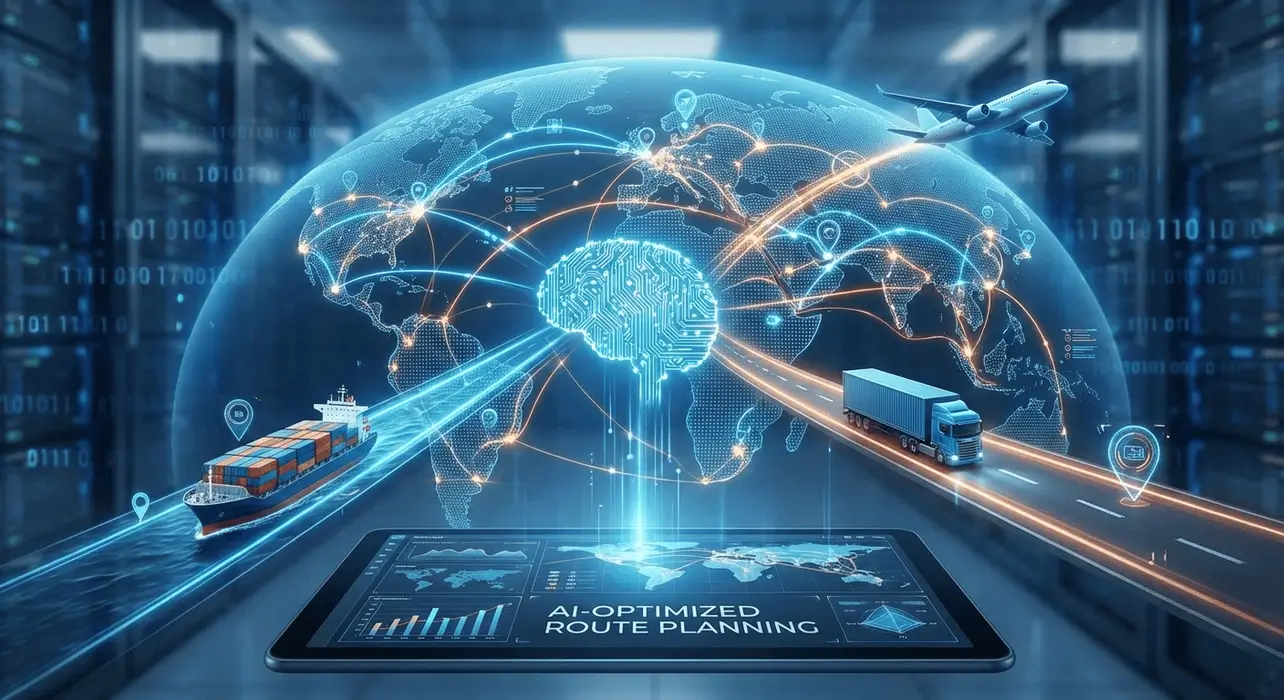
The challenge in contemporary logistics management is that businesses are under pressure to achieve faster delivery at a reduced cost and environmental impact. Artificial intelligence has come in as a new solution that has assisted shipping companies in devising delivery routes more efficiently than ever before.
The AI route optimization technology is a technology that is based on sophisticated algorithms and machine learning that can determine the optimal routes to follow by the vehicles, taking into account the current traffic conditions, weather variations, and customer needs. This strategy is a great way of enhancing the management of companies in their delivery operations and fleet management.
What is AI Route Optimization and Why It Matters
The AI route optimization system is an application that calculates and modifies the most efficient routes for the delivery vehicles automatically with live data. Contrary to the manual route planning that used to be done by human factors and patterns of historical occurrences, artificial intelligence systems consider the present conditions and make real-time decisions regarding the optimal routes to follow.
The process of logistics management has always been time-consuming. The route planners would take hours to map the delivery routes on maps and use pen and paper. This inefficiency is removed today with artificial intelligence in route planning, which can compute thousands of data points within a few seconds. The system takes into account the delivery points, the capacity of the vehicle, the time window, the traffic situation, and weather prediction at the same time.
In case the drivers encounter unforeseen challenges such as traffic jams or accidents, AI route planner algorithms will automatically recalculate the optimal alternative route. This on-the-fly optimization avoids delays and ensures deliveries are made punctually, which has a direct impact on customer satisfaction, and it also saves operational costs.
How AI Route Optimization Software Works
Current route optimization software is based on machine learning algorithms that are used to spot trends in delivery information. The system is informed by the historical data of traffic, demand trends, and driver behaviour to make more precise predictions over time.
The Data Collection Process
The AI route planning applications take in information provided by various sources. GPS positioning gadgets would give the position of vehicles, and traffic cameras and mobile applications would offer real-time traffic information. Weather stations provide forecasts and historical records of delivery provide the pattern of demand at various times and places. The computer program incorporates all this data in one analysis structure.
Artificial Intelligence (AI)-based Real-Time Route Optimization.
The most important benefit of AI-based logistics is that it can adapt in real-time. After assigning routes, the system constantly monitors the conditions. As the traffic congestion rises on the route planned, the software is able to calculate alternative routes that are time and fuel-saving. In case of adverse weather, the system is able to define the routes that are less risky or change the delivery dates.
The dynamic routing in real-time guarantees that the managers in charge of the logistics are always informed about the correct and up-to-date information concerning their fleet. They are able to reply instantly to customer requests, vehicle breakage, or delivery delays without having to recalculate manually.
Key Benefits of AI Route Optimization
By applying AI route planning technology, there are quantifiable advancements in various fields of logistics functions.
Cost Reduction and Fuel Efficiency
There is a direct cutting of transportation costs due to AI optimization. The software reduces the fuel consumption by computing the shortest distances and reducing unwarranted journeys. Studies indicate that firms that adopt the AI route optimization realize their mileage being reduced by double-digits following the adoption.
There is also reduced vehicle wear and tear since the routes are shorter, which increases the longevity of the delivery fleets. When routes are more efficient, overtime by drivers is eliminated, and labor costs are reduced further. These savings come fast, enhancing profit margins, and the budget is set at liberty to expand the business.
Faster and More Reliable Deliveries
The performance of the on-time delivery is guaranteed by AI route planning tools, which take into account realistic driving time and service windows. The system takes time and importance of the customer and delivers according to the urgency and thus delivers the urgency.
Artificial intelligence in route planning can react instantly with alternative solutions to unexpected situations. There is no longer a long delivery time due to traffic jams, weather, or road accidents. The reroutes made by the system are effected immediately, and service level agreements and customer expectations are not compromised.
Improved Customer Satisfaction
Customers appreciate quick and dependable deliveries with proper tracking of the delivery. Artificial intelligence logistics systems give real-time delivery information and precise arrival time forecasts. Customers will have confidence when deliveries are made on time.
Customer relationships are also enhanced by the capability of responding to any last-minute requests and urgent orders. AI-based logistics companies will be able to satisfy the special requests and emergency deliveries without changing the planned routes.
Environmental Benefits
Efficient routes save more fuel and also fewer vehicle emissions. AI route optimization offers direct benefits by reducing the carbon footprint of delivery operations by reducing the number of unnecessary trips and traffic congestion. Firms are under pressure to show environmental responsibility, and efficient routing is one of the viable ways.
Challenges and Implementation Considerations
Although the idea of AI route optimization has numerous advantages, it needs to be very thoroughly planned and executed to ensure its success.
Data Integration and Quality
The system of AI requires real-time data that is precise to operate effectively. Enterprises should make sure that traffic data, weather conditions, and the ability of vehicles to be tracked are integrated and effective enough. Routing decisions can result in poor routing due to obsolete or inaccurate data.
Another requirement of organizations is the ability to deal with the never-ending information channels presented by various sources. The lack of appropriate systems can make data bottlenecks slow any route calculation and lower the responsiveness of the system.
Driver Acceptance and Training
The AI systems will have to give routing advice that drivers will need to trust. Certain drivers choose well-known routes or are afraid of algorithmic decision-making. To implement it successfully, training programs that will show how AI route planning tools can enhance their daily working experience are necessary.
Communication of the purpose of route changes and how the system functions should be clear to facilitate adoption by the drivers. As soon as drivers realize that AI recommendations lower stress levels and enhance efficiency, they will be more likely to accept them.
The Future of AI in Logistics
The process of artificial intelligence in route planning will continue to be improved as the technology will be enhanced. The next goal in the logistics management field is integration with self-driving cars, drone delivery systems, and sophisticated traffic prediction models.
Machine learning algorithms will keep getting smarter and will learn on bigger datasets and draw more accurate predictions. Multi-objective optimization will help to equally consider many objectives, such as reduction of costs, speed of delivery, environmental effects, and customer preferences.
Conclusion
The use of artificial intelligence has completely reshaped the field of logistics management because it has enabled the field to have faster, smarter, and responsive route planning. The optimization software of AI route optimization has erased the time-consuming process of manual planning that characterized the logistics operations, and instead, it has introduced smart systems that respond immediately to the real conditions of the world.
Companies embracing AI route planning software enjoy a competitive edge in their operation in terms of low prices, rapid delivery, and enhanced customer satisfaction. The adoption of AI-based logistics is a pivot point for enterprises that are interested in staying competitive within contemporary supply chain management. In case you would like to employ professionals, you may rely on the services of Sea Trans Agencies.