


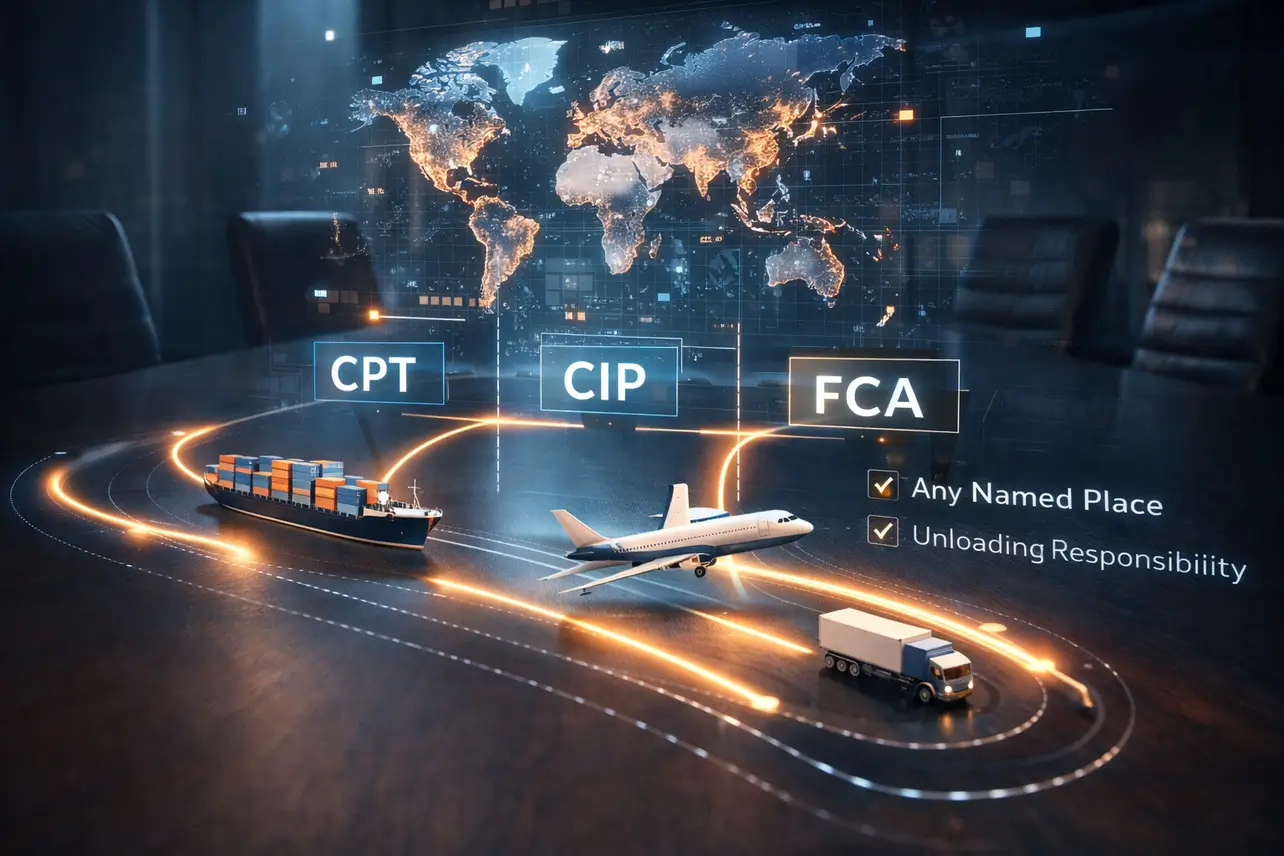
Global shipping mistakes cost businesses thousands of dollars every single year. Hidden fees appear because someone chose the wrong shipping term for the contract. Transport disputes happen when buyers and sellers misunderstand who pays for what. The CPT incoterm, along with CIP and FCA, can solve these problems completely.
These three terms control who handles transport costs and when risk transfers. This guide breaks down each option in simple language so you choose correctly. Understanding these rules protects your profit margins and keeps your supply chain running smoothly.
What Are Incoterms and Why They Matter
Incoterms are global rules that explain buyer and seller duties in trade deals. The International Chamber of Commerce made these rules to stop confusion and arguments. Each incoterm tells you who pays for the transport of your goods. It also says when the risk moves from the seller to the buyer.
You also learn who handles customs work and who pays for insurance coverage. Your choice of incoterm directly changes your profit and your overall costs. A wrong choice can lead to surprise fees and problems with your supply chain.
Understanding the CPT Incoterm: Carriage Paid To
What CPT Means
Under CPT, the seller pays to ship goods to a specific place. But the risk moves to the buyer once the first carrier gets the goods. This is important because the seller pays while the buyer takes the risk. The buyer bears loss or damage after risk transfers to the carrier.
Seller’s Responsibilities Under CPT
The seller must pay for several specific costs to move the goods.
- They handle export packaging and prepare all needed documents.
- They pay origin terminal charges and load goods onto the carrier.
- They cover all freight charges to get goods to the destination.
- They also handle customs clearance at the starting point of the shipment.
The seller arranges the whole trip to the final destination for the buyer.
Buyer’s Responsibilities Under CPT
Once the first carrier has the goods, the buyer takes full responsibility.
- The buyer pays for the goods as agreed in the contract.
- They pay all import duties and taxes when goods arrive.
- They cover unloading costs at the final destination point.
- They handle insurance if they want it and manage final delivery.
When to Use CPT
CPT is appropriate for multimodal shipments across different transport modes. It is common for goods moving by truck and then by ship. Freight forwarders suggest CPT when shipments go beyond just one port or airport. This term is useful for land transport across many different borders.
CPT vs. CIP: The Critical Difference
What CIP Incoterm Means
CIP is very similar to CPT but has one big difference. The seller must buy insurance coverage for the goods during the trip. Under CIP, the seller protects the buyer’s risk with a paid policy.
Key Difference: Insurance
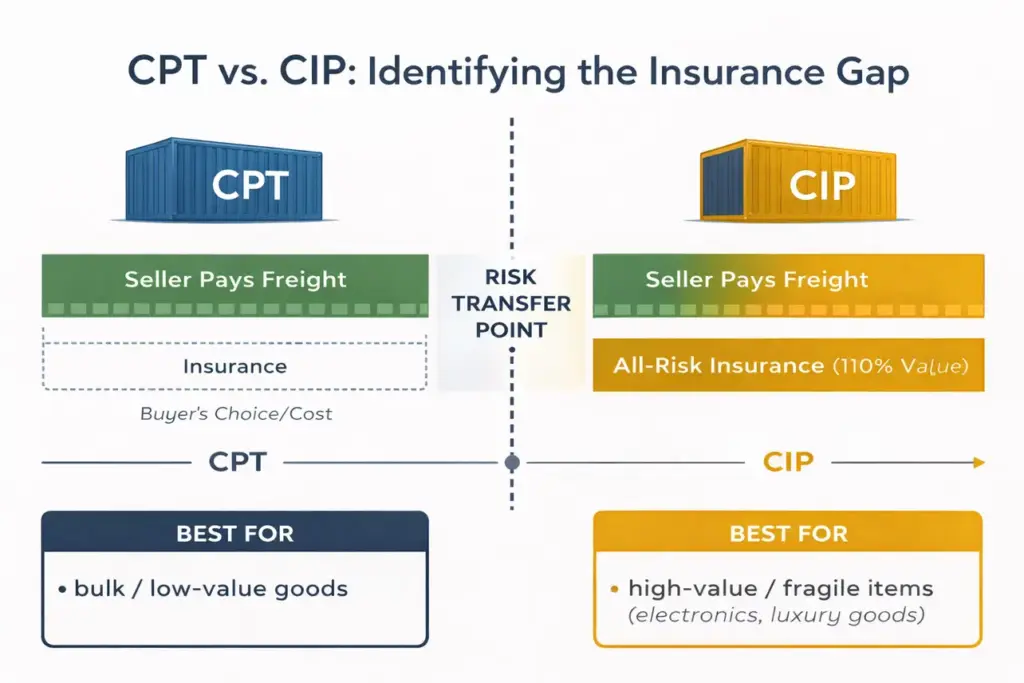
CPT: The seller pays only for transport, and insurance is not included. The buyer must buy their own insurance if they want protection.
CIP: Under CIP the seller must obtain insurance for the buyer’s risk during carriage. The insurance should meet Institute Cargo Clauses A and cover 110% of value.
When the Buyer Needs CIP
CIP is good if your goods are expensive or easy to break. The seller’s insurance pays for damage or loss while goods are moving. This is vital for electronics, drugs, or high-value luxury items.
Cost Implication
CIP costs more than CPT because the seller adds insurance costs. But the buyer gets safe coverage without doing any extra work. The seller usually adds this extra cost to the product price.
Understanding FCA Shipping: Free Carrier
What FCA Means
FCA means the seller delivers goods to a carrier the buyer chooses. The seller does not pay for the main transport of the goods. Risk moves to the buyer once goods reach the named place.
Risk Transfer Under FCA
This is the main point that makes FCA different from others. Risk moves right away at the seller’s place or a named spot. The buyer then controls the goods and pays for the transport.
Seller’s Responsibilities Under FCA
- The seller handles export papers and clears customs for the goods.
- They deliver goods to the carrier or place the buyer picks.
- If delivery occurs at the seller’s premises, the seller must load the goods.
The seller only needs to get the goods to the handoff point.
Buyer’s Responsibilities Under FCA
- The buyer picks the carrier and arranges the shipping details.
- They pay all costs to move the goods to the end.
- They handle insurance and pay for import customs clearance.
- They manage the final delivery to their own warehouse.
FCA gives the buyer the most control over the shipping process.
When to Use FCA
FCA is best when buyers have their own shipping deals ready. Importers like FCA because they can find cheaper freight rates themselves. It helps when you want to use a specific carrier you trust.
CPT, CIP, and FCA Comparison Table
| Aspect | CPT | CIP | FCA |
|---|---|---|---|
| Who Pays Transportation | Seller | Seller | Buyer |
| Insurance | Not included | Included (Seller pays) | Not included |
| Risk Transfer | When goods are handed to the first carrier | When goods are handed to the first carrier | At named location |
| Best For | Multimodal shipments | High-value goods | Buyer-controlled shipments |
| Cost for Seller | Medium | High | Low |
| Cost for Buyer | Low-Medium | Low | High |
Understanding DAT vs. DPU: An Important Update
What Changed in Incoterms 2020
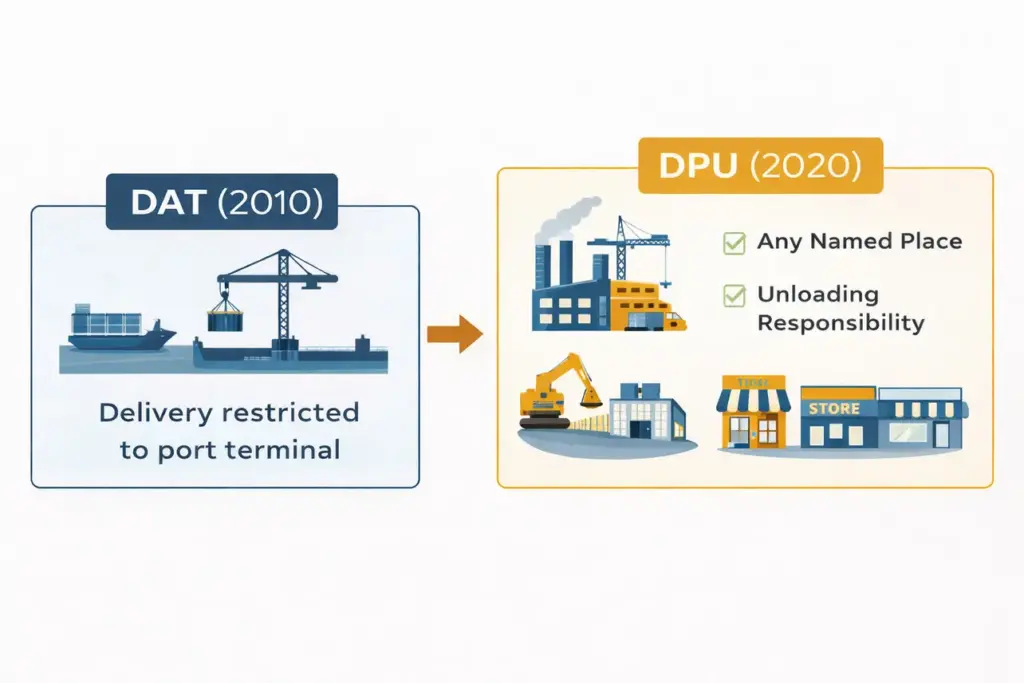
The old term DAT was replaced by DPU in the 2020 rules. This change helps clear up confusion about the word “terminal.” DPU stands for Delivered at Place Unloaded and is more flexible.
Key Difference
- DAT: This rule only applied to delivery at a specific terminal.
- DPU: This rule applies to delivery at any place you choose. This includes places that are not traditional terminals like ports.
Incoterms 2020 replaced DAT with DPU to improve delivery flexibility. Ask for DPU in quotations when the seller must unload goods at destination. Under DPU, the seller is responsible for unloading goods at the agreed place.
How Freight Forwarding Strategy Depends on Incoterm Choice
Your choice of incoterm changes your whole freight forwarding plan:
- Under CPT: The seller usually contracts and pays the agreed carrier for carriage. Risk transfers to the buyer when goods are handed to the first carrier.
- Under CIP: Your forwarder adds insurance to your service package for you. You pay more for this, but the buyer gets full safety.
- Under FCA: Your buyer picks the forwarder and handles the main transport. Your job ends once you hand over the goods to them. This saves you work but gives the buyer power over price.
The right choice depends on your business needs and your risks. A good forwarder knows these rules and can save you money.
Conclusion
The CPT incoterm, CIP, and FCA are key for global shipping success. CPT is great for multi-modal trips where you control the transport. CIP keeps high-value goods safe with insurance paid by the seller. FCA lets buyers manage their own logistics and pick their carriers. You must know these terms to make better contracts and save costs. Choosing the right term is the first step to a smooth supply chain.
If you want to hire professionals, you can trust SeaTrans Agencies for reliable service. Our team has 24 years of experience in global freight forwarding. We handle CPT, CIP, and FCA shipments across air and ocean. Contact us today to optimize your logistics strategy.