

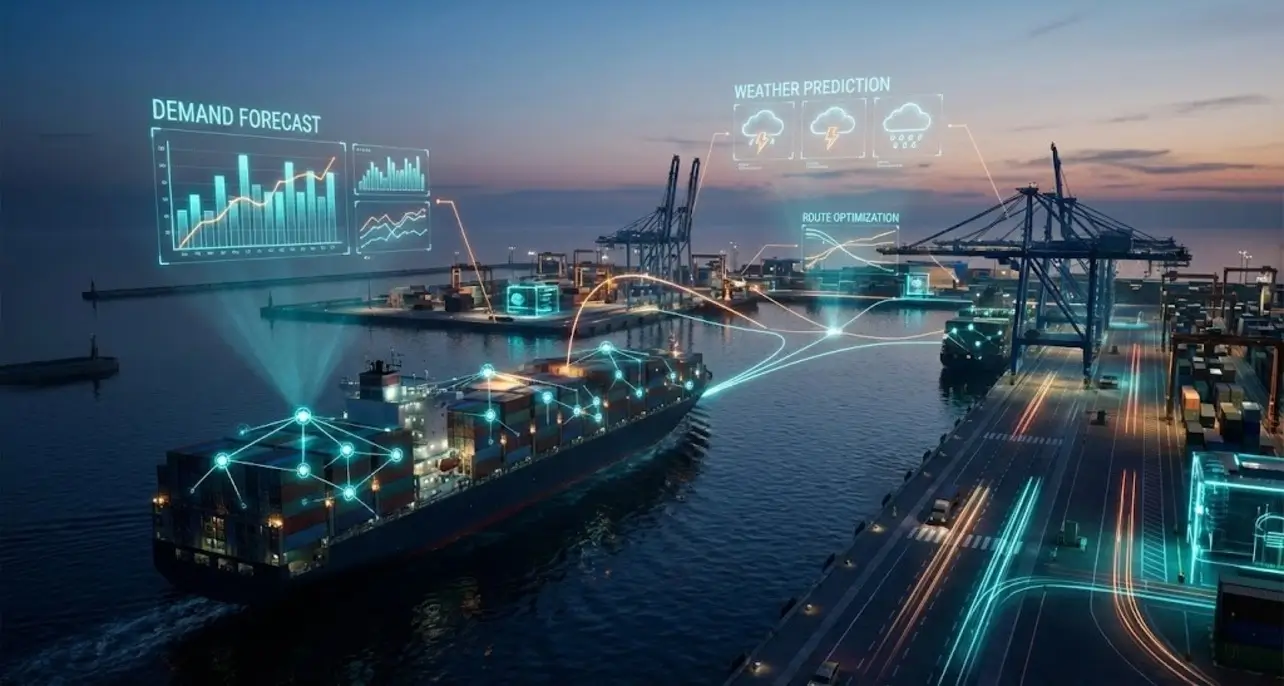
The pressures on supply chains always include the need to be quicker and keep the costs down. Predictive analytics is a solution that has become mighty and it assists companies to foresee issues in advance. Through the historical data analysis and the definition of patterns, the logistic companies will be able to predict the demand, optimize the routes and avoid delays.
It is a technology that makes freight forwarding a proactive strategy instead of a reactive one. The benefits of using predictive models in a company are immense as the companies experience reduced cost, better customer satisfaction and ease in the operations of the entire supply chain network.
How Predictive Analytics Transforms Supply Chain Operations
Predictive analytics involves statistical methods and machine learning to make sound predictions using past data concerning future events. These tools are used in logistics to analyze millions of data points such as previous shipping volumes, seasonal patterns, weather patterns, traffic, and carrier performance histories.
Patterns that are invisible to human beings are detected by the system. As an example, it may find out that deliveries to some parts of the world are always delayed at particular months of the year because of a regular weather. With this information, the logistics managers will be in a position to arrange alternative routes or rescheduling in advance.
Machine learning models keep on improving their accuracy. Every successful shipment presents new information that will optimize predictions. With time, the system gets more accurate in predicting variations in demand, transit times and possible delays.
The importance of Accurate Demand Forecasting to your business
How to prevent Inventory Problems Before they Cost You Money
Proper demand forecasting helps in avoiding two very expensive issues; stock out and overstocking. Whenever businesses make the wrong estimation of the need, they end up with the shortage of products, missed sales and disappointed customers. Excessive demand causes stock to be held in warehouses that have not been sold and consumes capital and storage expenses.
Predictive analytics analyses the previous sales data, market patterns, promotion schedule, and economic factors to predict demand very precisely. Retailers are able to know up to months or weeks in advance, the number of units to sell. This vision will enable them to make the right amount of orders and place deliveries well ahead of time.
Seasonal changes become foreseeable. The system will identify trends such as the high demand leading to the holidays or low orders during particular quarters. Businesses modify their logistics services to be sure that they have enough capacity during the peak and that they do not spend their resources during the slow periods.
Precision in Planning Capacity of Transportation
Capacity planning is necessary in the world logistics networks. It is costly to book a lot of trucks or containers. Lack of capacity leads to delays on shipment and emergency expediting expenses. Predictive models, based on demand forecasts, are used to find out precise transportation requirements in the near future.
These insights are utilized by freight forwarding companies to convince carriers into a better rate. Their ability to know their volume needs many months in advance enables them to get capacity contracts at good rates. This also helps the carriers as they can predict the volumes and use their fleet accordingly.
Demand forecasting is especially useful to air logistics. Air freight is expensive as compared to other modes of transport and precise planning is imperative. Predictive analytics allows the companies make decisions about which deliveries actually need air delivery and which are better delivered inexpensively by ocean or land.
Proven Strategies to Reduce Delays Using Predictive Intelligence
Smart Route Optimization Saves Time and Fuel
Delays in transportation cost and destroy customer relationships. Predictive analytics finds the quickest course, the most dependable one, through the examination of past transit time, road conditions and traffic patterns. The system takes into consideration factors such as road construction schedules, level of congestion in ports, and the rate of processing of customs in various border crossings.
Dynamic route optimization is a change in recommendations depending on the real-time conditions. The system will automatically provide alternatives in case of storms in the intended route due to weather forecasts. Such a proactive management helps to avoid delays even before they happen rather than responding to the emergence of problems.
There is also an improvement in multi-modal transportation decisions. The system looks at various transport options (air to a hub and ground delivery or direct trucking) and suggests the alternative that is most likely to meet the delivery deadlines at minimum cost.
Predicting Maintenance Needs Before Breakdowns Happen
Shipment delays are tremendous because of the breakdown of vehicles. Predictive maintenance utilizes sensor data of the trucks, ships, and aircrafts to predict when they are likely to fail. It is a system that will keep track of engine performance, tires, fluid levels, and other mechanical signals.
Keeping of the machines is done at the scheduled maintenance time and not in the case of an unexpected failure in the roadways or at sea. This is proactive in that it minimizes the time wasted due to machine breakdowns as well as prolonging the vehicle life and decreasing the costs of repairs.
Fleet managers are alerted when specific vehicles require some attention. The maintenance is planned in a way to reduce the operational setbacks and at the same time to make all the equipment reliable.
Staying Ahead of Weather and External Disruptions
Bad weather is a great source of logistics delays. Predictive analytics combines meteorological data to predict the influence of weather occurrences on the transport networks. The system does not anticipate the occurrence of storms but the specific roads that will be delayed and when.
This vision facilitates decisions beforehand. Companies are able to re-route deliveries prior to the strike of a storm, modify delivery assurances to their customers, or postpone travel until the weather is better. These measures ensure that the mayhem that accompanies unplanned weather does not live in the activities.
Other disruptions that are expected in the technology are port strikes, change in custom policy, and peak season overcrowding. Advance notifications enable the logistics services to come up with contingency measures that ensure the services are not affected by the external factors.
Key Advantages to Air Logistics and Freight Forwarding Companies
Reducing the Operational Costs With Data-Based Decisions
The operational cost is reduced in several aspects by predictive analytics. Proper demand forecasting saves on emergency shipping due to purchase of products that have adequate lead time. Optimization of routes reduces the transportation costs and transit time. Improved maintenance scheduling eliminates costly emergency repairs.
Predictive models of the volume of shipment to be received enhance the efficiency of warehouses. The facilities are staffed accordingly to prevent the use of overtime when the unexpected surge occurs and prevent idle workers when there is a drop. The use of space is enhanced since managers are aware of the products that are to be received and shipped in the near future.
The cost of insurance can be reduced since predictive risk assessment can help to detect the high-risk shipments that require additional protection and the low-risk loads that can be assigned lower premiums.
Enhancing Customer Satisfaction through Effective Delivery Assurances
Customers require proper delivery estimates. Predictive analytics gives realistic delivery windows as opposed to guesses. Transit time should be longer and better than desired when the companies explain the predictions to the customers who consequently will trust them more.
Satisfaction is also enhanced by proactive communication on the possible delays. Companies do not make customers know about late deliveries, but inform them early and offer them new schedules. Such openness is also professional and develops loyalty.
The ability to deliver on promises always forms competitive advantages. Companies with reputable logistics gain and maintain more customers as compared to the companies whose service is uncertain.
Achieving Competitive Advantage in the Traditional Competitors
Predictive analytics allow companies to run more efficiently than their counterparts who use traditional methods. They react quicker to market fluctuations, deal with disturbances in a more amicable manner and provide better service to their clients at reduced prices. These benefits are directly converted into market share and increase in profits.
Technological leadership in industries is created by early adopters. With the increasingly complex global logistics, the data-driven decision making isolates leaders and followers. Companies that take a long time to adopt predictive analytics run a risk of lagging behind those that streamline their operations with the use of advanced technology.
Essential Steps for Successful Implementation
Building a Strong Data Foundation
Predictive analytics relies on complete and precise data. Data of low quality generates inaccurate forecasts. It is necessary that the companies have systems that gather clean data covering all the relevant areas such as transportation management systems, warehouse operations, customer orders, and external feeds.
The problem of data integration occurs when the systems are not compatible in terms of formats. It pays to invest in good data infrastructure, which yields the benefits of making a more accurate prediction and making better decisions.
Choosing the Right Technology and Building Team Expertise
Predictive analytics implementation needs software and the expertise of personnel. Effective models can be constructed and maintained by data scientists who have an insight into logistics. A significant number of companies collaborate with technology providers that offer predictive analytics tools that are specifically aimed at logistics services.
Cloud solutions play down on implementation tasks. These platforms deal with data storage, processing power, and model development and companies are not dealing with infrastructure as they use insights.
Pilot projects mean confidence in the start. Demonstrating the value of predictive analytics in one sector stimulates the wider use of the technology within it.
What the Future Holds for Predictive Logistics Technology
The development of artificial intelligence capability keeps growing fast. The predictive models of the future will integrate additional data sources such as sentiment of social media, economic indicators and real time sensor networks. There will be accuracy and predictions will go a long way in the future with confidence.
Autonomous vehicle integration and drones will establish completely automated logistic chains that will continuously optimize themselves. Human supervision will still be required, yet the automatic decision-making of predictive insights will be carried out on a regular basis.
Predictive analytics can be improved using blockchain technology which can offer confirmed data regarding shipment conditions, custody transfers, and deliveries. Such transparency enhances the quality of data and minimises fraud and controversies.
Conclusion
Predictive analytics is changing the supply chain of today because the modern supply chain can now forecast its demand and achieve high levels of delay reduction. The use of such technologies in companies has resulted in quantifiable gains in terms of cost efficiency, customer satisfaction and operational efficiency.
The proactive response to upcoming issues and anticipation abilities ensure competitive advantages that increase with the complexities of global logistics. Although the implementation will necessitate the investment in technology and skills, its returns will compensate these investments in long-term operational excellence.
Should you wish to engage the services of experts who use best predictive facilities to ensure excellent freight forwarding and air logistics services, then you can be confident that you are in the hands of Sea Trans Agencies.